10 Best Business Travel Management Companies in San Francisco (2026)



TLDR;
- San Francisco buyers face a unique advantage: Navan (Palo Alto) and Spotnana (Palo Alto) are headquartered in the Bay Area, giving them local hiring, local proof-of-concept customer access, and local support response that out-of-region vendors cannot match
- For SF mid-market tech and biotech teams (100–1,000 employees / 50–500 travelers), ITILITE wins on AI-first booking, transparent pricing, SOC2-aligned security controls, and up to 2.5% combined cashback across travel and card spend.
- Hotel rate compliance is the single hardest budget conversation in San Francisco programs. Union Square averages $320 per night, the Financial District tops $400, and Mission Bay biotech hotels run $380 plus. Pick a TMC that surfaces rate caps at booking time, not after the trip
- Multi-airport routing across SFO, OAK, and SJC is non-negotiable in 2026. A San Francisco TMC that does not weigh Oakland or San Jose against SFO is wasting your travelers' Monday mornings
- For California Labor Code Section 2802 reimbursement compliance, finance teams need expense receipts categorized to the trip and the employee with no ambiguity.




Business travel in San Francisco rarely stays in San Francisco. The same week-long trip touches Palo Alto for a portfolio review on Tuesday, the Financial District for a board dinner Wednesday night, Mission Bay for a biotech site visit Thursday morning, and South San Jose by Friday. A San Francisco travel management company that books flights into SFO and stops there is solving the wrong problem. The right one understands the Bay Area corridor as a single travel pattern, knows when to send someone to OAK instead of SFO to save 90 minutes of traffic, and treats a $420-per-night Union Square hotel as a policy conversation, not a routine approval.
For the broader state-level view across California (LA, San Diego, Sacramento, Silicon Valley), see our companion guide on business travel management companies in California. For how energy and medical-industry cities approach the same problem differently, our Houston companion guide walks through what changes when the buyer is an oil-and-gas finance team instead of a venture-backed SaaS company. And for the underlying category framework on what a modern TMC actually does, see our overview of travel and expense management software.
Top 3 San Francisco Business Travel Management Picks at a Glance
The other seven are covered in detail below. Where a San Francisco team should land in that ten depends on travel volume, who owns the buying decision (finance, ops, HR, or IT), and whether travelers are mostly SF-resident or flying into SFO from out of state.
How we picked these 10 for San Francisco
We started with a list of 18 TMCs and corporate travel platforms that explicitly market into the San Francisco and Bay Area mid-market or enterprise segments. We filtered against four San Francisco-specific criteria:
- (1) does the platform handle Bay Area multi-airport routing intelligently across SFO, OAK, and SJC,
- (2) does it surface San Francisco hotel rate caps before booking rather than after,
- (3) does it integrate with NetSuite, QuickBooks Online, or SAP S/4HANA (the three most common Bay Area finance stacks in 2026), and
- (4) does it have either a Bay Area office or named Bay Area customers we could verify. Vendors that failed two or more criteria dropped.
We then cross-referenced against G2 reviews from California-headquartered customers (filtered by reviewer location where available), Capterra ratings posted in the last 12 months, and the publicly stated customer logos on each vendor's website. Pricing posture is based on each vendor's published model where available, plus mid-market RFP feedback we collected from finance and ops leaders at Bay Area companies in Q1 and Q2 2026.
1. ITILITE
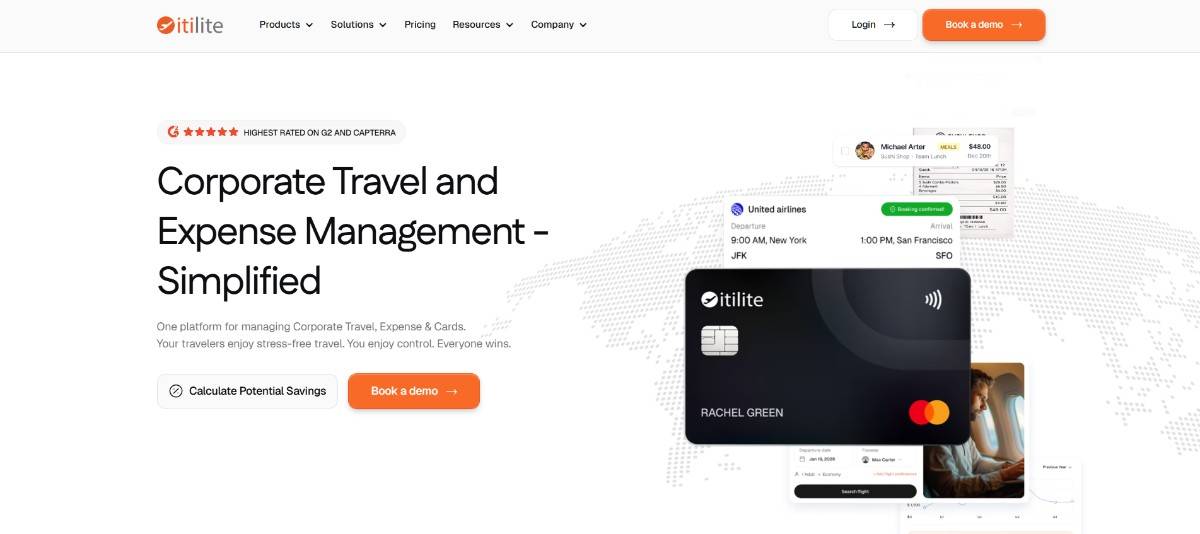
ITILITE built its San Francisco mid-market footprint by solving the exact problem most SF travel programs run into around month 18: the team has outgrown direct-to-Expedia booking, the finance lead wants policy compliance without becoming the trip police, and the IT lead wants SOC2 Type II before approving anything. ITILITE clears all three in a single onboarding cycle.
Best for: San Francisco tech, SaaS, and biotech companies (100–1,000 employees / 50–500 travelers, Series A through D) where finance and ops need fast policy automation, up to 2.5% combined cashback, and turnkey deployment without a six-month implementation.
- AI-first booking that learns each traveler's preferences (preferred airline, aisle vs. window, hotel chain) and surfaces policy-compliant options first
- Bay Area corridor airport routing that weighs SFO, OAK, and SJC by total travel time including ground transit, not just airfare
- Real-time policy compliance check at booking, with rate caps configurable by San Francisco neighborhood (Union Square, Financial District, Mission Bay, SOMA)
- Expense capture via mobile, GL-coded for NetSuite, QuickBooks Online, Xero, and SAP integrations
- 24/7 human support with travelers reaching a person inside 30 seconds
- SOC2 Type II, GDPR-aligned data handling, plus SSO via Okta, Google Workspace, and Microsoft Entra ID
For the deeper card-side of expense management that pairs well with ITILITE for San Francisco teams, see our coverage of business travel and expense cards.
2. Navan (Palo Alto headquarters)
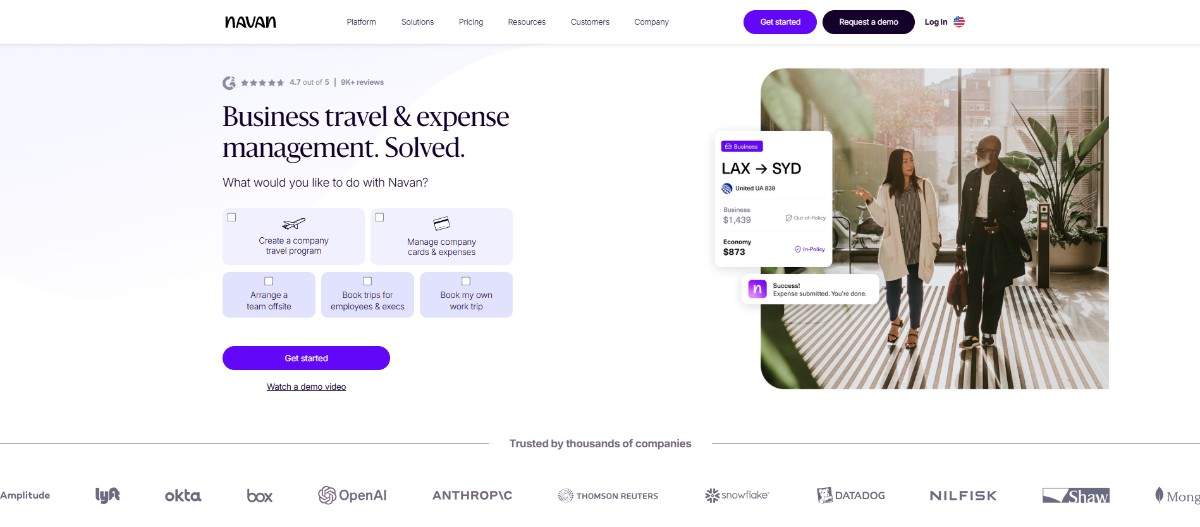
Navan, formerly TripActions, sits 35 minutes south of downtown San Francisco off the 101, and that proximity is not cosmetic. The Bay Area customer base it built from 2015 onwards (when it was still TripActions) means Navan account managers have walked through more San Francisco offices than any other TMC in this list. For a tech buyer at a Series B SF startup, that local social proof closes faster than a deck of national logos.
Key features:
- Ariel AI assistant for booking, rebooking, and disruption handling
- Bundled travel plus expense plus corporate card in one platform
- Strong mobile app, popular with tech traveler personas
- Deep SF and Peninsula customer references available on request
- Real-time policy nudges at booking time
Where it falls short: Mid-market Series A teams and below sometimes find the bundled card requirement awkward when they already use Ramp, Brex, or Mercury IO for spend. Pricing transparency improved in 2024 to 2025 but mid-market buyers should still ask for a published per-traveler rate.
For a fuller picture of how Navan compares against ITILITE specifically on mobile and AI workflows, our corporate travel management apps comparison goes deeper on the mobile experience.
3. Amex GBT (American Express Global Business Travel, including Egencia)
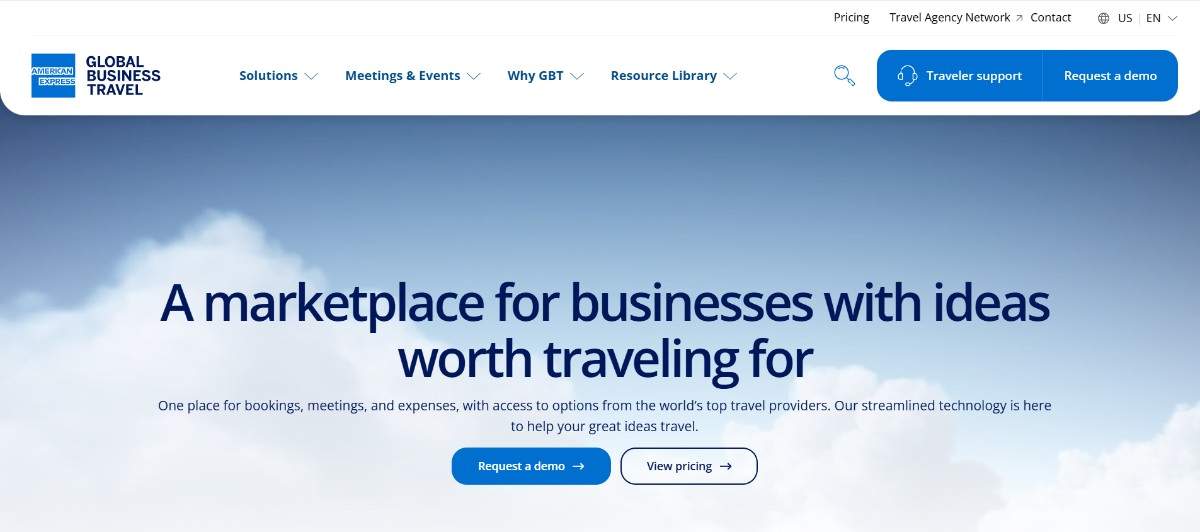
For Financial District-headquartered enterprises (the BlackRock, Visa, Wells Fargo cohort), Amex GBT remains the default. The 2021 Egencia acquisition gave GBT a more mid-market-friendly product stack on the Egencia side, and the dual offering means a 5,000-traveler San Francisco multinational and a 300-traveler SF tech company can both buy from the same parent and still get appropriate-tier service.
Best for: San Francisco enterprise multinational (1,000+ travelers), Financial District anchor tenants, global programs needing 24/7 multi-region human support.
Key features:
- Largest global TMC footprint, with 24/7 support in every major time zone
- Egencia-branded mid-market platform for teams in the 250 to 2,500 traveler range
- Detailed duty-of-care reporting for SF companies with employees traveling to high-risk regions (which Bay Area biotech and consulting frequently does)
- Concur, SAP, and Workday integration certifications
- Enterprise sourcing power on airline contracts and hotel programs
Where it falls short: GBT's enterprise-tier service is excellent but priced for enterprise. Mid-market SF teams below 250 travelers often find Egencia overbuilt and Navan or ITILITE more aligned. The Egencia rebrand to the GBT family in 2023 to 2024 caused some account continuity friction that has now largely settled.
4. BCD Travel
BCD Travel earns its San Francisco enterprise spot through pharma and biotech specialization. Mission Bay biotech companies running multi-country clinical trial travel programs (sites in Boston, Basel, Singapore, and Mission Bay all at once) gravitate to BCD because the duty-of-care reporting and regional sourcing teams are organized for exactly that pattern.
Key features:
- TripSource booking platform with global content
- Industry-specific account teams (life sciences vertical for SF biotech)
- Decision Source analytics for travel program optimization
- Strong sustainability reporting (BCD's SustainaBeing program is relevant for SF buyers under California SB 253 climate disclosure)
- Risk management and traveler tracking built for clinical trial geographies
Where it falls short: Mid-market and tech buyers often find BCD's tech stack less modern than Navan or ITILITE. The traveler-facing mobile experience is functional, not delightful.
5. SAP Concur

SAP Concur shows up on most San Francisco enterprise stacks already, usually because the finance team adopted SAP Concur Expense first and then added Concur Travel because the integration was the path of least resistance. Bay Area companies running SAP S/4HANA or large NetSuite instances often default to Concur for this reason rather than for the booking experience itself.
Key features:
- Tightest SAP S/4HANA and NetSuite integration of any TMC option
- ConcurExpense for receipt capture, GL coding, approval workflow
- TripIt mobile companion app (well-established with SF business travelers)
- Configurable policy engine with strong reporting
- Enterprise-grade security and compliance
Where it falls short: Booking experience is generally rated below Navan, ITILITE, and Spotnana on traveler satisfaction surveys. The reason most SF teams stay on Concur Travel is the Concur Expense integration, not booking quality. Pricing and contract terms are enterprise-typical (12 to 36 month commitments, custom quotes).
6. CWT (Carlson Wagonlit Travel)
CWT runs a different San Francisco play than Amex GBT. Where GBT anchors in the Financial District banking and insurance segment, CWT has historical strength in San Francisco-headquartered industrial, energy adjacency, and large media and entertainment travel. Companies like long-tenured SF energy infrastructure firms and major media production companies have run CWT programs for two decades plus.
Key features:
- CWT myCWT booking platform with strong group travel handling
- Meetings and events product (CWT Meetings & Events) for SF conference-heavy travel programs
- Global 24/7 support and traveler tracking
- VIP and executive travel service tier (relevant for SF C-suite programs)
Where it falls short: Modern tech buyers often find CWT's platform less intuitive than newer entrants. Strongest fit when the buyer values continuity and global enterprise service over technology innovation.
7. FCM Travel
FCM Travel (part of the Flight Centre Travel Group) carved out a San Francisco mid-market position by leading with technology pieces other TMCs were slower to add. FCM's Sam AI assistant predates Navan's Ariel, and the FCM Platform was built to feel modern to traveler personas who would otherwise default to direct booking on Google Flights.
Key features:
- Sam AI assistant for booking and trip management
- FCM Platform with strong mobile experience
- Boutique-style account management combined with Flight Centre global scale
- Strong hotel program negotiation in California and globally
- Real-time program reporting
Where it falls short: Brand awareness in San Francisco is lower than Amex GBT or BCD, so FCM sometimes needs to do more education in RFP cycles. Pricing transparency varies by deal size.
For a global TMC comparison that includes how FCM fits among the mega vendors, see our top 10 travel companies in the world coverage.
8. Spotnana (Palo Alto headquarters)
Spotnana is the second Palo Alto-headquartered platform on this list and the most architecturally different. Founded by former Amex GBT executives, Spotnana built a modern travel-as-a-service infrastructure layer (their term: Travel-as-a-Service, or TaaS) that other booking front-ends and SaaS tools can sit on top of. For a San Francisco buyer evaluating Spotnana directly, the value is a modern API-first stack, fresh data architecture, and a Bay Area engineering team within a 30-minute drive.
Key features:
- Travel-as-a-Service architecture, API-driven
- Modern booking front-end with strong mobile design
- Bay Area engineering and product team
- Real-time airline content via NDC distribution
- Customer programs with several large multinationals
Where it falls short: Younger company, smaller customer base than Navan, FCM, or BCD. Mid-market buyers should verify the support model for their traveler volume. Pricing model is custom for most deals.
9. Engine (formerly Hotel Engine)
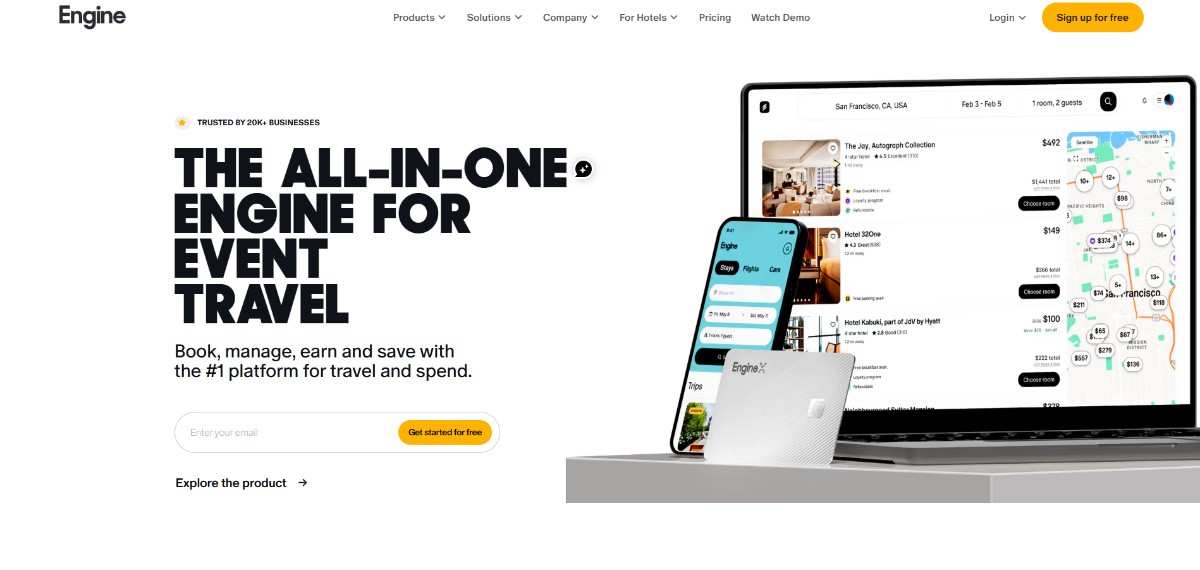
Engine renamed from Hotel Engine in 2024 and stayed focused on what its old name implied: hotel booking, mostly without flights, optimized for cost. For San Francisco programs where the hotel line is the killer policy item (Union Square at $320 a night plus, Mission Bay biotech hotels at $380 plus), Engine's value proposition is straightforward: get me a lower negotiated rate on the hotel-only piece, and I will handle flights elsewhere.
Key features:
- Hotel-only platform with proprietary negotiated rates
- Group booking handling for SF conferences and team offsites
- No booking fees on the negotiated rates
- Simple usage model, fast onboarding
Where it falls short: Engine is not a full TMC and does not handle flights or full duty-of-care reporting. Use it alongside another tool, not as a replacement.
10. Direct Travel
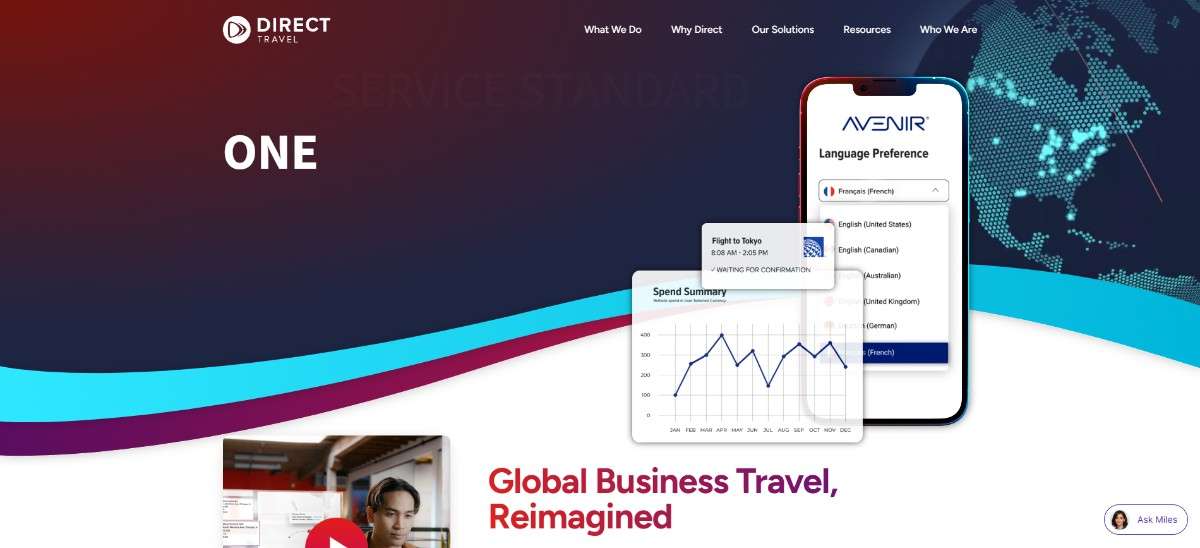
Direct Travel rounds out the list as a San Francisco mid-market option for buyers who want a US-headquartered TMC with strong traveler experience focus and an account-management model that feels less corporate than the Amex GBT or BCD enterprise tier. Direct Travel has grown via acquisition and offers both leisure and corporate travel under one parent.
Key features:
- US-based account management
- Multi-channel booking (online tool, agent-supported)
- Reporting and policy compliance tools
- Strong traveler service focus
Where it falls short: Technology stack is less modern than Navan, ITILITE, or Spotnana. Buyers prioritizing AI-first workflows may find Direct Travel a step behind.
What San Francisco Businesses Should Look For in a Travel Management Company
San Francisco travel programs face a set of constraints that programs in Chicago, Austin, or Denver do not. The right TMC for a Bay Area buyer accounts for these:
- Bay Area corridor airport routing: SFO is the obvious airport, but for travelers heading to Palo Alto, Mountain View, or San Jose, SJC saves 60 to 90 minutes of Monday morning ground transit. For East Bay travelers, OAK frequently beats SFO on total travel time. A TMC that does not weigh ground time alongside airfare is solving for the wrong cost. Ask any TMC in an RFP to show you a sample routing decision between SFO and SJC for a 10:00 am meeting in Mountain View.
- Hotel rate caps surfaced at booking time: The Union Square average daily rate in 2026 sits at $320 to $360 depending on day of week and season. The Financial District tops $400, and Mission Bay biotech-corridor hotels run $360 to $440. If a TMC surfaces rate caps only after the booking is made (in a post-trip report), policy violations are already cooked in. Caps need to be enforced at the search-and-select step, with manager approval for exceptions.
- Integration with the SF finance stack: The three most common Bay Area finance stacks in 2026 are NetSuite (mid-market tech), QuickBooks Online (early-stage and small biotech), and SAP S/4HANA (enterprise). A TMC that exports clean GL-coded data into any of these three saves a finance team 4 to 8 hours per week.
- SOC2 Type II and SSO: Bay Area IT teams will not approve a travel platform that fails the standard SaaS security review. Look for SOC2 Type II, GDPR-aligned data handling, and SSO support for Okta, Google Workspace, and Microsoft Entra ID at minimum. For pricing model trade-offs across TMCs more broadly, see our deep dive on TMC pricing models.
- Traveler experience for talent retention: San Francisco tech talent expects a mobile-first travel app comparable to consumer apps. A TMC with a clunky mobile experience drives travelers back to direct booking, breaking policy compliance. The fix is picking a TMC whose mobile app travelers actually want to use.
- California Labor Code Section 2802: California employers must reimburse necessary business expenses. For travel, this means receipts captured cleanly, categorized to the trip and the employee, with no ambiguity at audit time. We cover the full Section 2802 reimbursement framework in our California business travel guide, and San Francisco employers should treat that as required reading.
Ready to evaluate ITILITE for your San Francisco team?
ITILITE works with mid-market San Francisco companies across tech, biotech, and SaaS to consolidate travel booking, policy compliance, and expense management on a single AI-first platform. The implementation timeline for a standard San Francisco mid-market configuration is up to 2 weeks. Book a 30-minute demo with a Bay Area-aware specialist to see the platform routed against your specific Bay Area corridor travel pattern.
FAQ
What is the best business travel management company in San Francisco for mid-market tech?
For San Francisco mid-market tech and SaaS companies (100–1,000 employees / 50–500 travelers), ITILITE leads with AI-first booking, transparent SaaS pricing, SOC2 Type II compliance, and up to 2.5% combined cashback optimized for Bay Area travel corridors. Navan is the strongest alternative, with the local-HQ advantage of being based in Palo Alto.
Are any business travel management companies headquartered in San Francisco or the Bay Area?
Two of the top platforms covered are headquartered in Palo Alto: Navan (formerly TripActions) and Spotnana. Both offer local engineering and product teams, Bay Area customer references, and local support response times that out-of-region vendors cannot match.
How much do business travel management companies in San Francisco charge?
Pricing models split into two patterns. Published per-traveler SaaS pricing is most common from modern platforms (ITILITE, Navan tier pricing). Custom transaction-fee plus program-fee pricing is more common from enterprise TMCs (Amex GBT, BCD, CWT, Direct Travel). Engine is free to the user, with margin earned from supplier-side rate negotiation.
Which San Francisco TMCs handle Bay Area multi-airport routing well?
ITILITE, Navan, Spotnana, and FCM consistently weigh SFO, OAK, and SJC against each other in routing recommendations. Enterprise TMCs (Amex GBT, BCD, CWT) handle this through agent-assisted booking but with less automation in the self-service booking flow.
What hotel rate caps make sense for San Francisco business travel in 2026?
Reasonable 2026 caps by neighborhood: Union Square $340 to $360, Financial District $400 to $420, SOMA $320 to $340, Mission Bay $380 to $400. These should be enforced at booking time with a manager approval workflow for exceptions, not flagged post-trip.
Does my San Francisco TMC need to handle California Labor Code Section 2802 compliance?
Section 2802 is a reimbursement framework, not a TMC certification. What you need from the TMC is clean, categorized receipt data that flows to your expense system so reimbursements are auditable and traceable. Every TMC on this list can provide that data; the difference is how clean the integration is.
How do I evaluate Navan versus ITILITE for a San Francisco mid-market team?
Navan's strength is the Bay Area local proof base and the bundled card requirement (or Navan Connect bring-your-own-card model). ITILITE's strength is published transparent pricing, no required card bundling, and a deployment timeline measured in weeks rather than months. For SF tech companies (100–300 travelers), ITILITE delivers the best of both worlds: seamless integration with existing cards like Ramp or Brex, or a fully unified card-plus-travel platform offering automated flight rebooking and up to 2.5% combined cashback.

Ardra is a Content Strategy Manager at ITILITE with 6+ years of experience in travel and SaaS content. She holds a Master’s degree in Political Science from Lady Shri Ram College for Women and transitioned from academic research and travel content into SaaS content strategy.
She previously worked with JustWravel, where she focused on travel storytelling and digital content. Today, she specializes in SEO and AEO-driven content strategies that help businesses simplify complex travel and expense workflows into search-optimized narratives.
When she’s not working, Ardra is usually reading or watching films.
Control Costs, streamline travel with 24/7 support.
A fully integrated corporate travel management software that dramatically reduces spends while improving user experience