





- First-Party Research by ITILITE
- Based on 3,000+ buyer conversations across 15+ industries
- January 2025 – February 2026
Most companies know what they spend on airfare. Few know how much they lose after a ticket is canceled.
When a business traveler cancels a non-refundable ticket, the value typically converts into an airline credit that can be applied to a future trip. In theory, those credits help organizations recover travel spend. In practice, many are never used, scattered across traveler profiles, booking tools, and airline systems until they quietly expire.
Industry estimates suggest companies forfeit between 5% and 11% of unused airline credit value each year. ITILITE's own tracked data points to a significantly larger problem: 25.1% of total credit value was never recovered.
To understand what's driving this, ITILITE analyzed more than 3,000 corporate travel platform evaluation conversations conducted between January 2025 and February 2026, spanning organizations of varying sizes across 15+ industries, with participants from finance, operations, procurement, travel management, and executive leadership.
Three things became clear.
- Unused airline credits are not a niche concern. The topic came up in nearly 18% of all buyer conversations, placing it among the top five operational issues raised during travel platform evaluations.
- The urgency is increasingly coming from finance and operations, not travel managers. Buyers are treating credit recovery as a cost-control problem, with direct implications for budget accountability.
- And there's a significant gap between what buyers want and what platforms actually offer. The most-requested capability, blocking a new booking when an applicable credit already exists, remains unavailable across every major platform.
Six Findings Every Corporate Travel Buyer Should Know
Finding 1: The issue surfaces in nearly one in five evaluations.
Unused airline credits appeared in roughly 18% of all buyer conversations analyzed, placing it alongside policy enforcement, reporting quality, service levels, and booking functionality as a top-five operational concern. And it rarely shows up in isolation: when one stakeholder raises it, others tend to follow.
Finding 2: Most organizations still manage credits manually.
In 53% of cases where the issue was discussed, buyers reported relying on spreadsheets maintained by finance or executive assistants, shared email threads with TMCs, or no system at all. When ownership of that tracking changes hands, visibility into credits typically disappears with it.
Finding 3: For many organizations, the loss is already realized.
About 26% of buyers weren't talking about potential credit leakage, they were describing credits that had already expired. This shifts the conversation from optimization to actual financial waste, and it's what tends to trigger an immediate reevaluation of travel management processes.
Finding 4: Finance is driving the urgency, not travel teams.
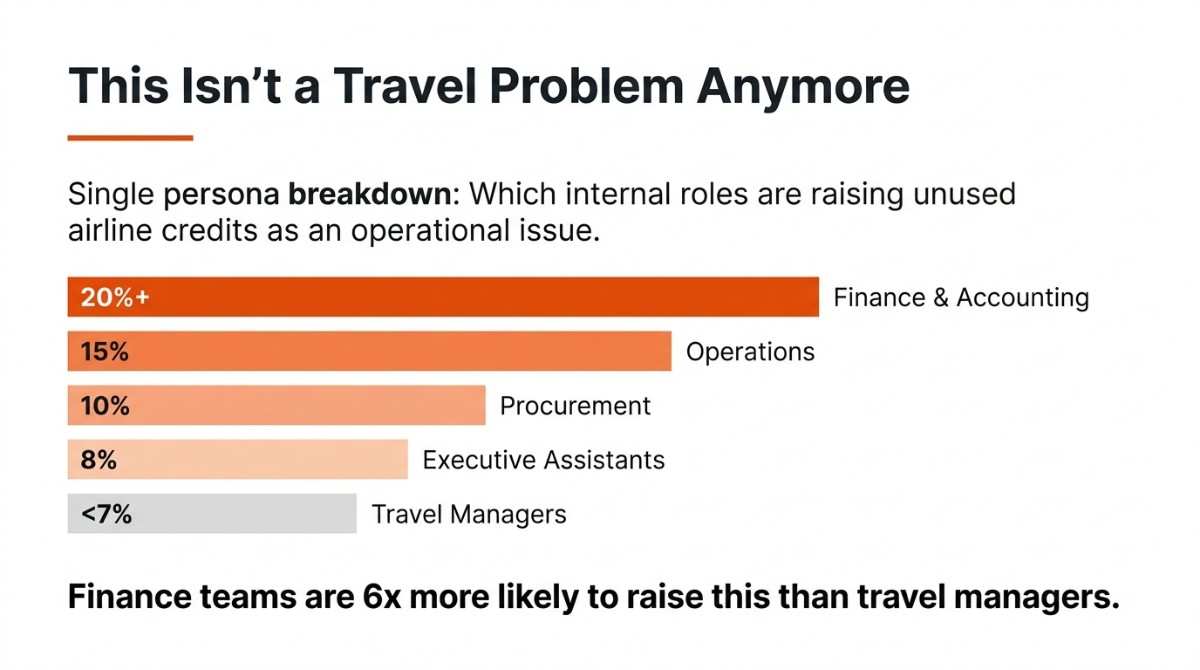
Finance, procurement, and operations stakeholders accounted for more than 45% of all credit-related discussions. Travel managers appeared in fewer than 7%. The framing has shifted: this is now a financial control issue, not a travel operations concern.
Finding 5: The problem persists even in mature enterprise systems.
Roughly 31% of affected organizations use SAP Concur, and 15% use Navan. The continued presence of credit loss in these environments suggests that existing systems either don't prioritize credit recovery workflows or don't surface them in a way that drives consistent action.
Finding 6: Enforcement remains the missing capability.
The most consistently requested feature across all evaluations wasn't better visibility into credits, it was the ability to enforce credit usage at the point of booking. Specifically: block a new reservation when an applicable credit already exists. No major platform currently offers this.
What Buyers Said - Directly from Recorded Conversations
- "When we try to rebook, we always get the notification… we don't have to keep track of our credits, right?" - Logistics & Supply Chain buyer
- "Is there a way for us to mandate unused airline credits?" - Controller
- "If something gets canceled through your program, then what happens? Does that credit go back into our account? Does it go into your account? Is it going to the provider?" - Executive Assistant
- "We had no way of telling who was where and the same applied to credits. We could only see leakage at the end of the month, after the window had already closed." - Director, Finance & Admin
The Numbers Behind the Problem
| Stat | Detail |
|---|---|
| 18% | Of all platform evaluations raised unused credits unprompted |
| 53% | Of affected buyers track credits manually today |
| 26% | Of affected buyers are already experiencing realized loss |
| 59% | Used the word "visibility" when describing what they need |
| 35% | Asked specifically about cross-airline tracking |
| 14% | Asked about expiration mechanics |
| 9% | Asked about credit transferability between travelers |
| 5% | Explicitly asked about mandate or hard enforcement |
Platforms in use among buyers who raised the credit issue:
| Platform | Share |
|---|---|
| SAP Concur | ~31% |
| Navan | ~15% |
| Other / Legacy TMC | ~34% |
| No platform / unmanaged | ~20% |
Why Credits Go Unrecovered: The Four Failures
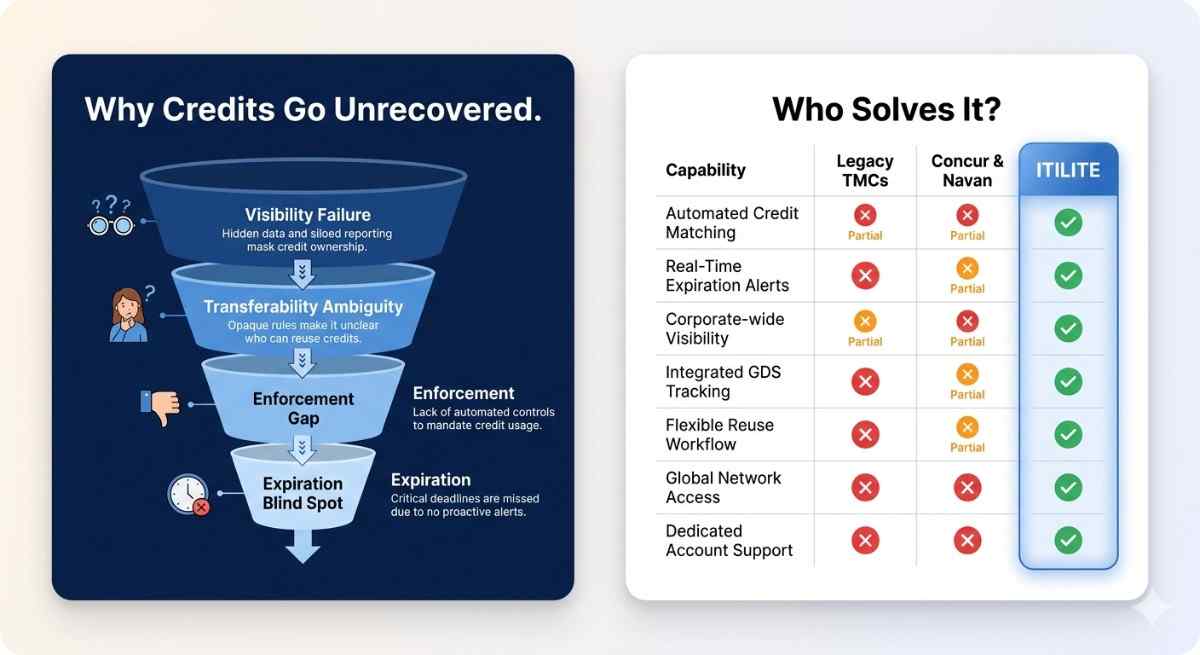
Airline credit leakage isn't caused by a single gap. It's the result of four reinforcing failures that operate across visibility, policy, and execution. Fixing one without addressing the others just shifts the point of breakdown.
1. Visibility Failure
Credits exist, but they're not surfaced when decisions are made. In most organizations, credits don't appear during flight search, aren't reliably applied at checkout, and don't show up in dashboards used by finance or operations. The credit is in the system. It's just not in the workflow.
2. Transferability Ambiguity
Buyers consistently asked whether credits can be moved between travelers, centralized under the company, or recovered when an employee leaves. The honest answer varies by airline, fare type, and cancellation conditions and most platforms don't normalize that complexity in a way that lets buyers make consistent decisions.
3. The Enforcement Gap
Most platforms provide visibility into credits and may offer auto-apply. But none provide a hard enforcement layer that prevents a new booking when an applicable credit is available under the same conditions. Recovery is left to individual behavior rather than system design.
4. The Expiration Blind Spot
Without proactive tracking and alerts, the standard 12-month validity window becomes passive. Credits expire silently. Organizations typically identify the loss only during reconciliation, long after recovery is possible.
How the Leak Actually Happens
- A non-refundable ticket is canceled and converted into a credit tied to the traveler's profile. The organization isn't automatically notified.
- The credit sits in airline systems or traveler accounts, invisible in the booking workflow.
- A new flight is booked on the same airline — with no system prompt, no enforcement. A full-fare ticket is purchased instead.
- The credit expires. The loss shows up in reconciliation weeks or months later.
The Financial Model: What Leakage Costs a Mid-Market Company
- Composite organization: 500 traveling employees
- 7 trips/year
- 15% cancellation rate
- Median fare $323
| Metric | Calculation | Result |
|---|---|---|
| Annual trips booked | 500 × 7 trips | 3,500 trips |
| Non-refundable cancellations | 3,500 × 15% | 525 credits/year |
| Total credit value generated | 525 × $323 | $169,575/year |
| At 11% leakage (industry high) | $169,575 × 11% | $18,653 forfeited/year |
| At 25.1% leakage (ITILITE actual) | $169,575 × 25.1% | $42,563 forfeited/year |
| Manual tracking cost (0.1 FTE) | $75K salary × 10% | $7,500/year |
| Total annual cost of inaction | Leakage + overhead | $26,153 – $50,063/year |
Median fare of $323 derived from ITILITE's tracked credit dataset of 2,617 USD-denominated credits.
Leakage rates: industry estimate from Christopherson Business Travel (11%); ITILITE actual from internal credit tracking data (25.1%).
Who Is Most Affected
Industries where credit loss shows up most often:
| Industry | Share | Why |
|---|---|---|
| Healthcare Staffing & Hospital Recruiting | ~32% | Clinicians cancel late. Non-refundable fares. Credits bound to a rotating workforce. |
| Oil, Energy & Manufacturing | ~7% | Project-based travel. A cancelled trip ties credit to a job code. Unrecovered credit = project write-off. |
| Software & IT Services | ~6% | Distributed teams flying multiple carriers. Cross-airline tracking requirement is sharpest here. |
| Construction | ~5% | Project-billable travel. Credits lost when a job closes before the credit is used. |
| Professional Training & Education | ~5% | Event-driven travel with high cancellation variability. |
| Non-profit & Association | ~4% | Grant-funded programs where every dollar is auditable. |
| Accounting & Financial Services | ~4% | Finance-led travel programs; controllers often own the credit problem directly. |
Who's raising the issue inside organizations:
| Persona | Share of Credit Conversations |
|---|---|
| Finance & Accounting (combined) | 20%+ |
| Operations | ~15% |
| Procurement | ~10% |
| Executive Assistants | ~8% |
| Travel Managers | <7% |
The Airline Policy Landscape
Unused credits aren't a platform problem in origin. They're an airline-policy problem that platforms either solve, paper over, or ignore.
Standard expiration by major US carrier (as of February 2026):
| Carrier | Credit Type | Standard Expiry | Expiry Start | Key Detail |
|---|---|---|---|---|
| United Airlines | Future Flight Credit | 12 months | Original ticket purchase date | Pandemic-era credits (2020–2022) extended through Dec 31, 2026 |
| Delta Air Lines | eCredit | 12 months | Original ticket date | Allows credit-on-credit rebooking, effectively resetting the expiration clock |
| American Airlines | Trip Credit | 12 months (AAdvantage) / 6 months (non-members) | Cancellation date | Non-members get half the window; clock starts at cancellation, not purchase |
| Southwest Airlines | Travel Funds | 12 months (standard) / 6 months (Basic) | Original ticket date | Policy changed May 27, 2025 — credits formerly never expired |
| JetBlue Airways | Travel Bank Credit | 12 months | Original ticket date | Variations apply to Blue Basic fares |
| Alaska Airlines | Credit Certificate | 12 months | Varies by fare type | Mileage Plan members may have extended flexibility |
Three things that apply across all major carriers:
- Credits are held by the airline, not the platform. A United credit sits in MileagePlus. A Delta credit sits in SkyMiles. The platform can surface, track, and apply the credit, it doesn't hold it.
- The new ticket must typically equal or exceed the credit value. Rebooking fees and fare differences apply in many cases.
- Transferability is carrier-specific and credit-type-specific, not a blanket yes or no.
The Transferability Question, Answered by Airline
9% of buyers raised transferability explicitly. Vendors often answer it vaguely. The real answer is more nuanced than yes or no.
Credits that can transfer between travelers:
| Airline | Credit Type | Transferable? | Note |
|---|---|---|---|
| United Airlines | All credits except MCOs | Yes | Broadest transferability of any major US carrier |
| Delta Air Lines | Open credits | Yes | Partial credits are not transferable |
| American Airlines | Open credits | Yes | Partial credits are not transferable |
Credits that cannot transfer:
| Airline | Credit Type | Transferable? | Note |
|---|---|---|---|
| Delta | Partial credits | No | Only open/full credits transfer |
| American | Partial credits | No | Only open/full credits transfer |
| Southwest | All credits | No | Bound to original traveler |
| JetBlue | All credits | No | Bound to original traveler |
| Alaska | All credits | No | Bound to original traveler |
| All airlines | MCOs | No | Non-transferable across all carriers |
From ITILITE's analysis of $931,940 in tracked credits across United, Delta, and American, the three carriers where partial or conditional transferability exists - $228,288 was ultimately not used before expiration. Some portion of this may have been recoverable through reassignment, but wasn't acted on within the available window.
The operational gap isn't whether credits can be transferred. It's whether organizations have the system-level visibility to know which credits are transferable, under what conditions, and at what point in time they need to act.
What ITILITE's Own Credit Data Shows
This report is built on a real tracked dataset: 2,626 airline credits across 1,984 trips, denominated primarily in USD, tracked from January 2025 to the present.
- $1.18 million in total credit value tracked.
- $392,052 successfully recovered - applied toward future travel. Recovery rate: 33.3%.
- $488,173 still active and unused - credits that exist, are visible in the platform, and can still be applied before expiration.
- $295,732 already expired, forfeited to airlines. Leakage rate: 25.1%.
- $70,417 at risk in the next 90 days - 190 unused credits expiring before August 22, 2026. That money exists today. It won't in 90 days.
That 25.1% figure matters in context. The industry estimates most commonly cited — 5–11% — come from individual TMC commentary on unmanaged programs. ITILITE's figure comes from a managed platform where credits are tracked, surfaced, and reportable. The leakage is happening even when the platform is working. That's the scale of the problem.
By airline:
| Airline | Total Tracked | Recovered | Still Unused | Expired |
|---|---|---|---|---|
| Delta (DL) | $378,068 | $111,276 | $209,129 | $57,663 |
| American (AA) | $284,383 | $95,626 | $106,055 | $82,702 |
| United (UA) | $268,489 | $97,903 | $82,372 | $88,213 |
| Southwest (WN) | $115,678 | $42,141 | $37,634 | $35,903 |
| JetBlue (B6) | $27,459 | $8,287 | $16,649 | $2,523 |
| Alaska (AS) | $27,022 | $14,309 | $8,971 | $3,742 |
What Buyers Want vs. What Platforms Deliver
| Capability | What Buyers Want | Legacy TMCs | Concur / Navan | ITILITE |
|---|---|---|---|---|
| Credit visibility at flight search | Tag before selecting a flight | ✗ | Partial | ✓ |
| Credit visibility at checkout | One-click apply at payment | Partial | ✓ | ✓ |
| Admin Unused Ticket Report | Company-wide rollup with expiry | ✗ | Partial | ✓ |
| Cross-airline tracking | All airlines, one view | ✗ | Partial | ✓ |
| 90/60/30-day expiration alerts | Automated admin warnings | ✗ | ✗ | ✓ |
| Hard booking enforcement | Block new booking when credit available | ✗ | ✗ | ✗ |
| Self-service, no agent fee | Apply credit without TMC cost | ✗ | ✓ | ✓ |
Assessment based on buyer-reported experiences and publicly available product information as of February 2026.
How ITILITE Approaches Credit Recovery
- Triple-surface visibility. Credits appear in three places: a "flight credits available" tag on search results, one-click apply at checkout, and a centralized Unused Ticket Report in the admin dashboard. 59% of credit-related conversations named visibility as the core need.
- Cross-airline rollup. A single view of every outstanding credit across every airline, per traveler and company-wide. 35% of conversations asked specifically for multi-airline tracking.
- 90/60/30-day expiration alerts. Automated warnings before credits expire, so finance teams can act while recovery is still possible.
- Self-service, zero agent fees. Credits are applied by the traveler at booking, no TMC agent required, no per-application fee.
- Credit-level transferability mapping. ITILITE maps transferability at the credit level, not just the airline level. United open credits: transferable. Delta and American open credits: transferable. Partial credits and all Southwest, JetBlue, Alaska, and Contour credits: not transferable.
- Delegate-booker support. In healthcare staffing and recruiting programs where coordinators book on behalf of travelers, credits are stored on the traveler's profile and surfaced at the next booking, even when the coordinator is doing the booking.
"Our grant-funded travel program requires every dollar to be auditable. The credit tracking feature, automatic at search and checkout - is a non-negotiable for us." - Operations Manager
"Credit recovery is one of the highest-ROI features for an organization with frequent international travel and high cancellation volume." - Global Outreach Specialist
The Bottom Line
Airline credit leakage isn't driven by lack of awareness. It's driven by the absence of a unified execution layer across visibility, policy constraints, and booking workflows.
The organizations that close this gap won't be the ones with better reporting alone. They'll be the ones that translate visibility into consistent, time-bound action across the travel lifecycle.
Research Methodology
This report is based on first-party analysis of 2,000+ corporate travel platform evaluation conversations conducted between January 2025 and February 2026. Each conversation represents a real buyer interaction, including documented attendees, deal context, and full meeting transcripts.
The dataset spans 15+ industries, with organizations ranging from small businesses to upper mid-market enterprises. Airline credit-related conversations were identified through structured keyword analysis, yielding approximately 500+ relevant conversations (18.4% of the full dataset).
All buyer conversations are drawn from ITILITE's CRM dataset, from recorded sales meetings where attendees consented to recording. No personally identifiable information beyond job title has been included. Credit tracking data is reported in aggregate only.
Airline policy details are accurate as of February 2026 and are subject to change. Competitive platform assessments are based on buyer-reported experiences and publicly available product information as of February 2026.
© 2026 ITILITE. All rights reserved. Reproduction in whole or in part requires written permission.
ITILITE is a travel and expense management platform that unifies booking, policy enforcement, automated expense reporting, corporate card controls, and real-time reconciliation into a single interface.

Ardra is a Content Strategy Manager at ITILITE with 6+ years of experience in travel and SaaS content. She holds a Master’s degree in Political Science from Lady Shri Ram College for Women and transitioned from academic research and travel content into SaaS content strategy.
She previously worked with JustWravel, where she focused on travel storytelling and digital content. Today, she specializes in SEO and AEO-driven content strategies that help businesses simplify complex travel and expense workflows into search-optimized narratives.
When she’s not working, Ardra is usually reading or watching films.
Never miss another airline credit again
A fully integrated corporate travel management software that dramatically reduces spends while improving user experience