8 Best Christopherson Business Travel Alternatives in 2026 (Compared)
%20(1).avif)

Snapshot

- SaaS TMCs (ITILITE, Navan, TravelPerk) replace Christopherson's managed-service model with self-serve software, unified travel-expense-card workflows, and 2-to-6-week rollouts versus a multi-month managed-service contract negotiation
- Managed-service peers (FCM, CTM, Direct Travel, Egencia) keep the agent-led model Christopherson uses, just at different scales and account-team continuity profiles
- SAP Concur is the enterprise software-led play and is already a Christopherson partner, so software-and-TMC can be reconfigured without a full vendor switch
- Christopherson customers leave most often for three reasons: renewal pricing climbs faster than travel volume, the AirPortal-plus-Concur-plus-bank-card stack creates reconciliation tax, or the program outgrows US-anchored support
- For US mid-market businesses wanting platform consolidation, ITILITE is the closest fit; for those wanting traveler app experience, Navan; for those staying managed but wanting a peer alternative, Direct Travel is the closest analog to Christopherson itself
Christopherson Business Travel is a family-owned, Utah-headquartered managed TMC founded in 1953. The product is AirPortal, their proprietary booking and reporting platform, paired with agent-led service and a specialization in US mid-market and government travel. The model works for customers who want a named account team, US-anchored support, and the institutional knowledge of a sixty-plus-year-old agency.
It also has predictable trade-offs. Christopherson is US-focused, so global programs outgrow it. AirPortal is a booking tool, not a unified travel-expense-card platform, so finance teams running travel through Christopherson, expense through Concur, and corporate cards through a bank carry the usual three-vendor reconciliation work. And renewal pricing on managed-service contracts climbs the way it does for most mid-market TMCs.
The 8 alternatives below are the platforms Christopherson customers actually shortlist when they look elsewhere. Three are SaaS-led TMCs (faster rollout, unified workflows, modern UX). Five are managed-service options at various scales (peers and step-ups within the agent-led model).
Among the SaaS-led group, ITILITE is the unified travel-expense-card pick most often shortlisted alongside Navan and TravelPerk; among the managed-service group, FCM and CTM lead at the upper end and Direct Travel sits closest to Christopherson on size and operating model.
At-a-glance comparison
| Vendor | Type | Best for | Starting price |
|---|---|---|---|
| ITILITE | SaaS TMC + expense + card | Mid-market wanting unified T&E | $10 per trip |
| Navan | SaaS TMC | Tech-forward US mid-market | Free tier up to 200 users |
| SAP Concur | Enterprise software + TMC partners | SAP/Oracle shops, CB's current partner | Custom quote |
| FCM Travel | Mega-TMC managed service | Mid-to-large enterprise, global | Custom quote |
| Corporate Travel Management (CTM) | ASX-listed global mid-market TMC | North America + APAC programs | Custom quote |
| Direct Travel | US-headquartered managed TMC | US mid-market wanting peer alternative | Custom quote |
| Egencia (Amex GBT) | Managed TMC platform | Mid-market under Amex umbrella | Custom quote |
| TravelPerk | SaaS TMC | SMB self-serve + European travel | Free tier available |
How to read the list
Christopherson customers leave for one of three reasons, and each reason points at a different group above.
- You want a unified platform, not a stack: Three SaaS picks (ITILITE, Navan, TravelPerk) bundle travel, expense, and corporate cards on one interface. If your finance team is paying the three-vendor reconciliation tax today, the SaaS group is where you're looking.
- You want a different managed-service provider: FCM, CTM, Direct Travel, and Egencia all run the same managed-service operating model Christopherson does, just at different scales and geographies. If the agent-led model works for you and the issue is the specific vendor (pricing, service tier, global reach), these are the peers and step-ups.
- You're moving up-market: SAP Concur is the enterprise software-led play that several Christopherson customers consider when their travel program complexity outgrows mid-market managed service. Christopherson is already a Concur partner, so the data-flow familiarity is real.
SaaS TMCs
1. ITILITE
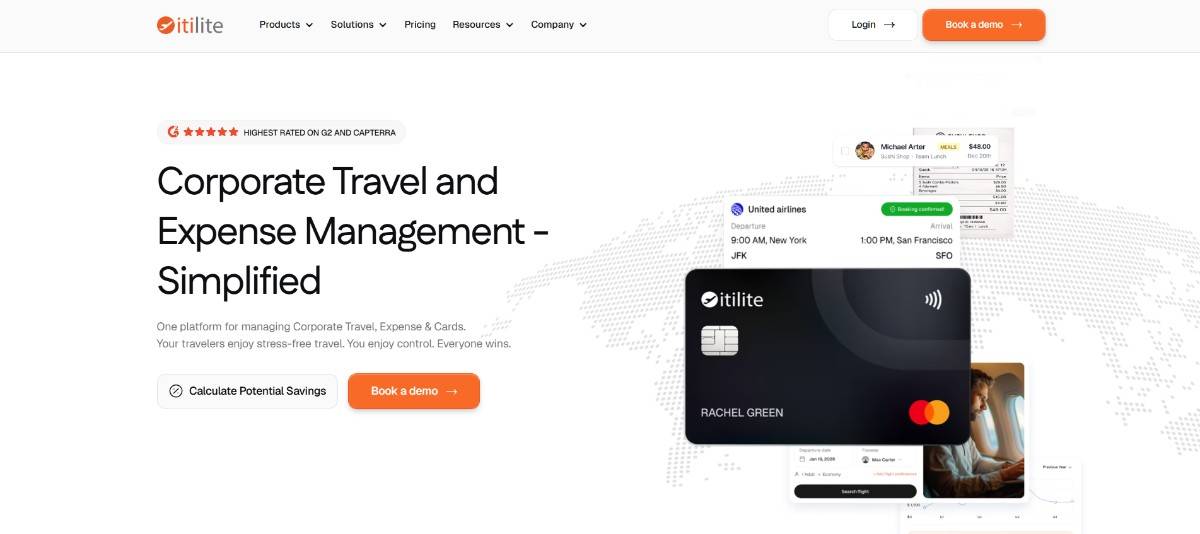
ITILITE replaces the AirPortal-plus-Concur-plus-bank-card stack with a single platform. The shift matters most to finance teams whose AP lead spends multiple days each month reconciling Christopherson's transaction data against their expense system and corporate card statements. On ITILITE, the booking IS the expense, the card swipe IS the spend control, and the reconciliation work compresses from days to minutes.
Pricing departs from both the managed-service model (transaction fees plus management fees) and the SaaS per-user model. ITILITE charges $10 per trip, which suits programs with a few high-frequency travelers and many infrequent ones better than per-active-user pricing does.
Key capabilities
- Online booking across 800+ airlines and 2M+ hotels on managed inventory
- Per-trip virtual cards eliminating hotel CCA form fraud risk entirely
- Direct connectors to NetSuite, QuickBooks, Sage Intacct, Workday HRIS
- Round-the-clock traveler support in multiple time zones
Where it fits: US mid-market organizations (100 to 1,000 employees) tired of running travel and expense as separate vendor relationships.
Cost structure: Flat $10 per trip with no implementation charges, no monthly user fees, no inactive-user billing.
2. Navan
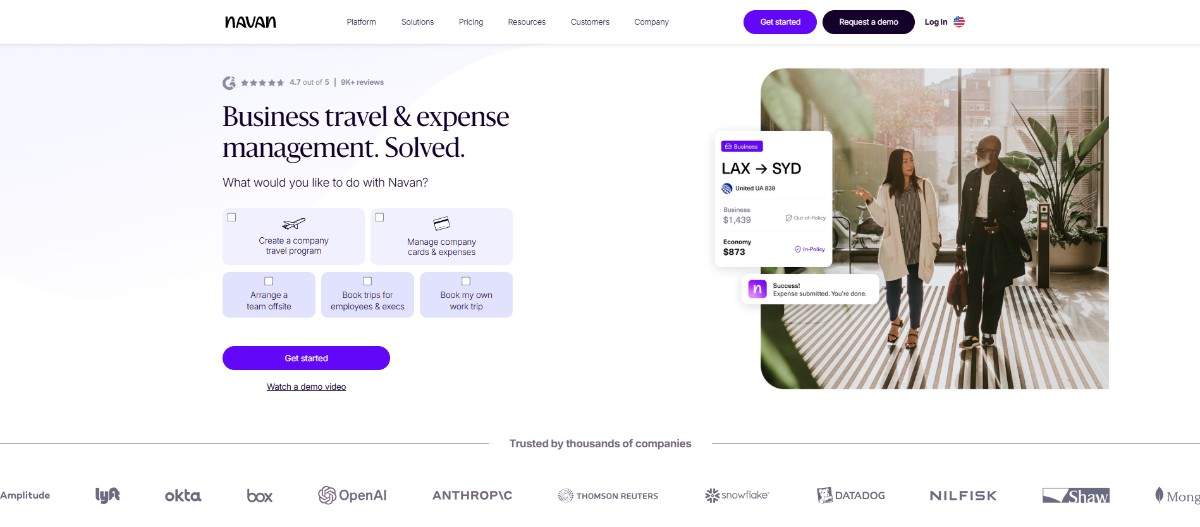
Navan competes for Christopherson customers on a different dimension: traveler experience. AirPortal serves the travel manager and the finance team well, but it isn't where individual travelers want to spend their time. Navan's mobile app was built to feel like a personal travel app, which fixes the recurring pattern of travelers booking on Expedia and submitting reimbursements rather than using the corporate tool.
The free tier covering up to 200 active users is the easiest way for a Christopherson customer to pilot a SaaS alternative without renegotiating their CB contract immediately.
Key capabilities
- Best-in-class traveler mobile app and booking experience
- Per-employee, per-department, and per-vendor card controls
- In-app traveler support 24/7 with escalation to phone
- Booking-rewards mechanism that incentivizes in-policy choices
Where it fits: Technology and professional-services mid-market businesses where traveler adoption has been the recurring pain point with Christopherson or any prior tool.
Cost structure: Free tier covers programs under 200 active users. Navan Connect for advanced expense and corporate cards uses custom pricing. Source:
3. TravelPerk

TravelPerk is the SaaS TMC with European DNA, now expanding aggressively into US mid-market since 2023. For Christopherson customers running US-only programs, the US-versus-European positioning isn't decisive. For CB customers with European subsidiaries, sales teams visiting Europe, or growing international travel needs, TravelPerk's local supplier relationships and rail integration outpace Christopherson's US-focused capabilities.
FlexiPerk is the distinguishing feature: pay a small surcharge per booking and recover roughly 80% of the cost on any cancellation, including non-refundable flights. For programs with plans-change-often travel patterns, the math typically works out.
Key capabilities
- Combined air, hotel, rail, and car booking on one interface
- FlexiPerk cancel-anything insurance on every trip
- GreenPerk emissions accounting and carbon offsetting
- Tiered traveler support with chat as the primary channel
Where it fits: US mid-market companies with European travel volume or European subsidiaries, plus programs prioritizing booking flexibility above traditional rewards optimization.
Cost structure: Free for small teams under usage threshold. Usage-tiered pricing scales above that.
Managed-service TMCs (Christopherson peers and step-ups)
4. FCM Travel
FCM is Flight Centre Travel Group's B2B arm and one of the major managed TMCs in the mid-to-large enterprise tier. The product offers a Sam:] AI travel assistant, Hub:] booking and expense platform, and access to FCTG's negotiated supplier network. For Christopherson customers outgrowing US mid-market into multi-country programs, FCM is the natural step-up within the managed-service model.
Best for: Mid-to-large enterprise customers with significant APAC travel or multi-country operations. Programs that value account team continuity at a larger scale than Christopherson can deliver.
Pricing: Custom quote, transaction fee plus management fee.
5. Corporate Travel Management (CTM)
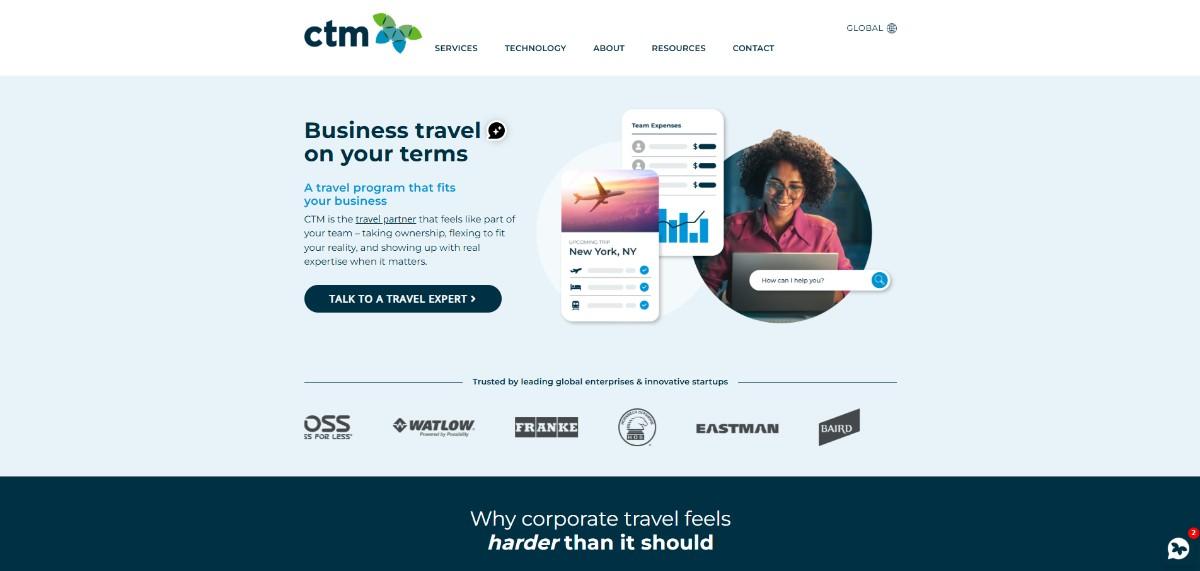
CTM is an ASX-listed global TMC that grew aggressively into North America through its 2020 acquisition of Travel & Transport. It's now one of the top six global TMCs by managed spend, with particular strength in North America, APAC, and government and not-for-profit niches.
For Christopherson customers who like the agent-led model but want a larger global account team and access to broader supplier negotiations, CTM is the peer-plus-scale alternative.
Best for: Mid-to-large businesses in North America, APAC, and EMEA with $5M to $50M in annual travel spend.
Pricing: Custom quote with transaction-fee pricing.
6. Direct Travel
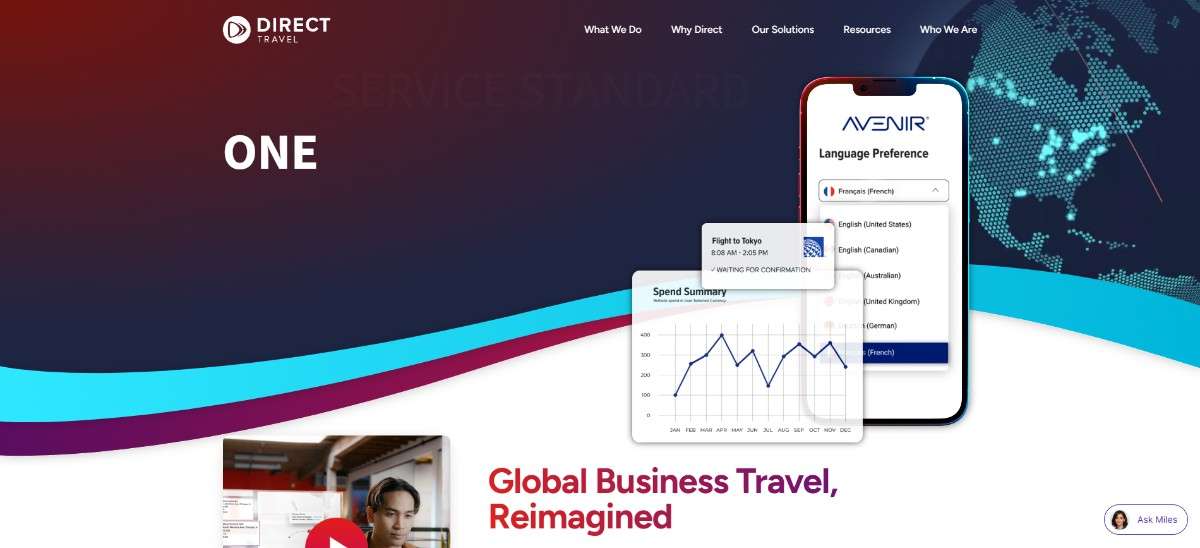
Direct Travel is a Denver-headquartered TMC that grew through acquisitions including Travel & Transport's Americas business and several regional TMCs. The product is most directly comparable to Christopherson on size, geography, and operating model: both are US-headquartered managed TMCs serving mid-market businesses with named account teams.
The reason a Christopherson customer considers Direct Travel: same managed-service model, different vendor, different account team. Most useful when the issue is specifically the vendor relationship (account turnover, pricing dispute, service quality) rather than a desire to move off the managed-service model entirely.
Best for: US mid-market businesses wanting a peer alternative to Christopherson without changing the operating model.
Pricing: Custom quote, transaction fee plus management fee.
7. Egencia (Amex GBT)
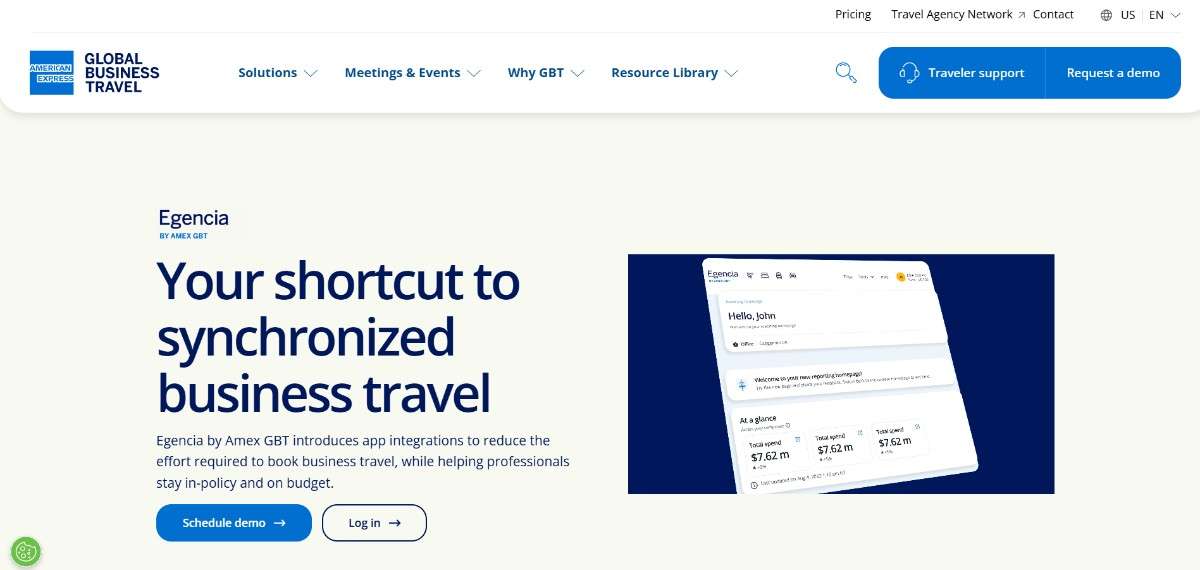
Egencia was the SaaS TMC pioneer in the 2010s before American Express Global Business Travel acquired it in 2021. The product still operates under the Egencia brand and combines a modern booking tool with managed service and Amex GBT's supplier negotiation depth.
For Christopherson customers who want a balance between SaaS-style booking and managed-service support, Egencia sits in the middle. Post-acquisition, the product roadmap has slowed; customers in 2026 generally see Egencia as comparable to other managed mid-market TMCs rather than the SaaS-leader it was in 2018.
Best for: Mid-market businesses comfortable with the Amex GBT umbrella who want managed service plus a modern booking interface.
Pricing: Custom quote. Source: Egencia.
The enterprise software option
8. SAP Concur

Christopherson is already an SAP Concur partner, so most CB customers have some Concur exposure already. SAP Concur is the enterprise software-led play: deepest ERP integrations in the category (especially SAP S/4HANA and Oracle), broadest integration marketplace (Uber, Lyft, Marriott direct), and the strongest compliance depth for global multi-entity programs.
The trade-off is implementation time (4 to 6 months for most rollouts versus 2 to 6 weeks for SaaS alternatives) and the multi-vendor model: Concur sells software, but fulfillment happens through a TMC partner network. Christopherson is one of those partners today. If you want Concur's software backbone with a different TMC partner, that's a real option without leaving Christopherson behind entirely.
Best for: Large enterprises already on SAP or Oracle ERP, or mid-market businesses with global compliance requirements that exceed Christopherson's US-focused capability.
Pricing: Custom quote. Implementation fees apply.
So which one?
The right answer depends on what you're actually solving for.
- If you're tired of three-vendor reconciliation: (travel through Christopherson, expense through Concur, cards through a bank), pick a unified SaaS platform. ITILITE if you want platform consolidation with per-trip pricing. Navan if traveler app experience is the issue. TravelPerk if European travel is meaningful.
- If you like the managed-service model and the issue is the specific vendor, look at Direct Travel as the closest peer, FCM and CTM as step-ups for larger global programs, Egencia for a middle option with modern booking.
- If you're outgrowing mid-market entirely and need enterprise software depth, Concur is the move. Worth noting: Concur and Christopherson aren't mutually exclusive. Some companies move to Concur software while keeping Christopherson as their TMC partner inside the Concur partner network.
A travel program manager at a mid-market services firm we spoke with described their CB-to-ITILITE move this way: "Christopherson was great at the agent piece. We just realized our finance team was spending two weeks a month reconciling travel data from AirPortal with expense data from Certify. We wanted one platform."
If platform consolidation is the real goal, ITILITE is the one to pilot first. The $10-per-trip pricing model means you can run a 90-day trial without committing to per-user fees, and the unified travel-expense-card workflow is the structural change most CB customers find genuinely different from anything they've used before.
FAQ
Why do companies leave Christopherson Business Travel?
The most common reasons are renewal pricing climbing faster than travel volume, wanting a unified travel-expense-card platform versus the multi-vendor stack AirPortal sits inside, and outgrowing Christopherson's US-anchored capability when the business expands globally.
What's the difference between Christopherson Business Travel and FCM?
Christopherson is a US-headquartered family-owned mid-market TMC focused on US travel and government. FCM is part of Flight Centre Travel Group, an ASX-listed global TMC focused on mid-to-large enterprise across multiple continents. Both run managed-service models with named account teams; FCM operates at meaningfully larger scale and broader geographic reach.
Is there a SaaS alternative to Christopherson Business Travel?
Yes. ITILITE, Navan, and TravelPerk are the three SaaS-led TMCs Christopherson customers most often shortlist. All three ship as software with fast self-serve rollouts (2 to 6 weeks versus a managed-service contract negotiation), pair travel with expense and corporate cards, and price per user or per trip rather than per transaction.
How long does it take to switch from Christopherson to a SaaS TMC?
Typically 2 to 6 weeks for SMB and mid-market customers. The timeline depends on data export from AirPortal, GL mapping to the new tool, and traveler onboarding. Switching to another managed-service TMC (FCM, CTM, Direct Travel) typically takes 8 to 16 weeks because of contract negotiation, supplier rate transfer, and account team setup.
Can I keep Christopherson as a TMC and switch the software?
Yes, if you move to Concur. Concur sells software and uses a network of TMC partners for fulfillment. Christopherson is one of those partners. Companies that want Concur's software backbone without losing their existing Christopherson agent relationships can configure the program that way.

Ardra is a Content Strategy Manager at ITILITE with 6+ years of experience in travel and SaaS content. She holds a Master’s degree in Political Science from Lady Shri Ram College for Women and transitioned from academic research and travel content into SaaS content strategy.
She previously worked with JustWravel, where she focused on travel storytelling and digital content. Today, she specializes in SEO and AEO-driven content strategies that help businesses simplify complex travel and expense workflows into search-optimized narratives.
When she’s not working, Ardra is usually reading or watching films.



Reduce the work behind every business trip
A fully integrated corporate travel management software that dramatically reduces spends while improving user experience
.avif)

%20(1).avif)