Executive Assistant Job Description (Modern 2026 Version + Template)


Last updated: March 2026
If you are an executive assistant in 2026 and are looking for a generic Executive Assistant job description template covering tasks like scheduling calls, booking travel (basically all the typical PA work), you have come to the wrong place. With AI-driven workflows and a hyper-competitive world, a traditional job description won’t get you where you want to go.
It’s going to be a bittersweet read for you in that sense, but that’s exactly the reality check you need right now. The first step to becoming an exceptional executive assistant is understanding what the role really involves.
- What does an executive assistant do?
- What roles and responsibilities do executive assistants handle?
- And most importantly, do you actually want to be one?
Let’s break it down, step by step, so you can see if this path is truly where you want to be and what it takes to get there.
What Does an Executive Assistant Actually Do? (Not just what job descriptions say)
It’s in the name, an Executive Assistant assists an executive.
Behind every good C-level executive is an executive assistant (EA) who’s running the show. Sure, the CEO might have their name on the company, but it’s the EA who manages their workload and ensures they have what they need to make big decisions. That’s why hiring a reliable, capable, and trustworthy Executive Assistant is so important.
You will find them handling everything from calendar management, file organization, expense reporting, travel coordination, and event planning to special projects and strategic support. There is no single standard. Some are design wizards, while others are spreadsheet experts.
They are often considered the RIGHT HAND of a Vice President or Chief Executive Officer. Executive Assistants play a critical role in an organization’s success by enabling leaders to focus on high-impact decisions. They perform essential tasks that keep operations running smoothly, such as:
- Calendar Management and Scheduling Appointments
- Coordinating travel and logistics
- Recording and documenting meetings
- Handling bookkeeping tasks
- Managing sensitive and confidential information
- Overseeing office supplies
- Acting as a liaison between stakeholders, executives, and the broader team
Right now, there are over 304,678 executive assistants working in the United States alone. 87% are women. The average age is 49, meaning this is an experienced, senior workforce, not an entry-level pool. Job listings for EAs grew 12% last year, with the highest demand concentrated in tech and finance.
And yet the Executive Assistant job descriptions companies are posting still read like they are looking for a secretary. That gap between what's written and what's real is exactly what this blog is going to fix. At its core, an Executive Assistant supports senior leaders, typically CEOs, CFOs, COOs, founders, or board members. But in modern U.S. companies, that support is strategic.
You are responsible for:
- Protecting executive time
- Filtering noise from priorities
- Anticipating problems before they happen
- Acting as a trusted gatekeeper
- Keeping leadership aligned and organized
| Category | Responsibilities |
| Executive Communication Management | Screening and drafting emailsManaging executive inboxesActing as liaison between executives and stakeholdersHandling confidential information |
| Calendar & Strategic Scheduling | Managing complex calendars across time zonesPrioritizing meetings based on strategic valueCoordinating board meetingsPreparing executive briefing materials |
| Travel & Logistics | Booking domestic and international travelManaging last-minute schedule changesCoordinating VIP logisticsProcessing expense reports |
| Operational & Project Support | Preparing reports and presentationsSupporting cross-functional initiativesTracking follow-ups and action itemsAssisting with special executive projects |
| Culture & Leadership Support | Planning executive retreats and company eventsActing as a connector across departmentsSupporting hiring or leadership initiatives |
The 2026 Executive Assistant Job Description Template (One That Actually Reflects the Role)
Job Title: Executive Assistant to the CEO
About the Role
We are seeking a highly capable Executive Assistant to act as a strategic partner to our CEO. You will serve as the operational backbone of the executive office, managing information flow, enabling decision-making, and ensuring the CEO’s time is focused on high-impact priorities. The ideal candidate is proactive, discreet, and comfortable leveraging modern tools to work smarter.
Key Responsibilities
- Manage a complex executive calendar, making independent prioritization decisions
- Coordinate domestic and international travel, including multi-city itineraries and real-time changes
- Process and reconcile expenses in partnership with finance
- Draft and manage executive communications, often representing the CEO’s voice
- Prepare board materials, investor decks, and executive briefings
- Serve as liaison to senior leaders, board members, and external stakeholders
- Lead special projects and cross-functional initiatives, owning outcomes
- Maintain strict confidentiality across company, personnel, and financial matters
- Improve executive office systems and processes proactively
- Support executive hiring and onboarding as needed
Required Qualifications
- 4+ years supporting C-suite or VP-level executives
- Ability to operate independently in fast-paced environments
- Exceptional written and verbal communication skills
- Proficiency in Microsoft Office and Google Workspace
- Experience managing international travel and executive expenses
- Strong discretion and judgment
Preferred Qualifications
- Experience with Asana, Notion, or Monday.com
- Familiarity with AI tools (e.g., ChatGPT, Claude, Notion AI, Otter.ai)
- CAP certification or equivalent
- Experience in high-growth or Series B+ environments
- Bilingual skills
AI Expectations
You should be comfortable using AI tools to draft, summarize, and research, while applying sound judgment about sensitive tasks. We expect curiosity and initiative, not technical mastery.
What We Offer
- Competitive compensation
- Direct exposure to executive strategy
- Growth path toward senior leadership support or Chief of Staff
- Comprehensive benefits and flexible work options
The Myth v/s Reality of Executive Assistant Job Description
Reddit has been actively discussing the question: “What does an Executive Assistant actually do?”
And honestly, you will never get the real answer from a job description. That only comes from experience. Before we talk about what really happens behind the scenes, here’s a comment from a fellow EA:
“Booking travel (flights, hotels, car services), scheduling and re-scheduling meetings, managing the exec’s calendar and keeping them on track. Coordinating events big and small, from ordering lunch for four to catering for 60. Handling purchasing sometimes office supplies, sometimes invoices. Everyone always needs something. People joke that ‘the place would fall apart without me.’ It’s funny… because it’s also partly true.”
— ToddPJackson, Reddit
Executive Assistant job descriptions make the role sound neat and organized, but the reality is far more dynamic. Understanding the gap between expectation and reality and knowing how to handle it strategically is what separates a good EA from a great one.
1. Calendar Management
- What the JD says: “Manage calendars and schedule meetings.”
- Reality: You will constantly re-schedule, handle overlapping priorities, and coordinate across multiple time zones.
- Strategic Approach: Build a buffer system in the calendar and use scheduling tools
2. Travel Arrangements
- What the JD says: “Assist with travel arrangements.”
- Reality: Booking flights and hotels is just the start. You’ll juggle last-minute cancellations, VIP preferences, multi-leg itineraries, and special requirements. If you are managing executive travel without a structured process, this executive assistant travel checklist covers every phase from 12 weeks out to post-trip reconciliation.
- Strategic Approach: Platforms like ITILITE enforce travel policies automatically at the point of booking, so last-minute compliance issues, out-of-policy bookings, and receipt chasing stop being your problem.
3. Reports and Presentations
- What the JD says: “Prepare reports and presentations with accuracy and professionalism.”
- Reality: Dealing with missing information, troubleshoot formatting, and creating deliverables under tight deadlines.
- Strategic Approach: Keep a running template library and track deadlines in a dashboard.
4. Communications Management
- What the JD says: “Handle communications professionally.”
- Reality: Emails, chat messages, and phone calls never stop.
- Strategic Approach: Use prioritization systems to categorize messages.
5. Event Coordination
- What the JD says: “Coordinate events.”
- Reality: Managing logistics, approvals, vendor issues, and last-minute changes.
- Strategic Approach: Create checklists and vendor playbooks.
6. Confidentiality
- What the JD says: “Maintain confidentiality.”
- Reality: Dealing with sensitive issues, and high-stakes information.
- Strategic Approach: Document decisions and communications carefully,
7. Proactive Support
- What the JD says: “Be a proactive support to executives.”
- Reality: You’re expected to anticipate problems and troubleshoot crises
- Strategic Approach: Track recurrent challenges and set up prep sessions with your executive
8. Flexibility
- What the JD says: “Flexible team player.”
- Reality: Being available outside normal hours
- Strategic Approach: Set boundaries where possible and communicate your availability.
These pressures compound over time in ways most job descriptions never acknowledge. For a deeper look at what Executive Assistants actually struggle with, read the full breakdown of challenges of an executive assistant - including burnout, scope creep, and AI anxiety.
The Real Scope of the Executive Assistant Role in 2026: Four Layers (One Nobody Is Talking About)
The modern Executive Assistant role operates across four distinct layers. Most job descriptions only describe the first one.
Layer 1: Operational
Calendar management, meeting logistics, travel booking, inbox management, expense reporting, and office coordination. This is table stakes. Any EA worth hiring already has this covered
Layer 2: Strategic
This is where strong EAs differentiate themselves. They prepare executive briefings, align priorities across teams, coordinate cross-functional initiatives, and often function as the decision-making nerve center of a leadership office.
Layer 3: Relationship
The Executive Assistant role operates as both gatekeeper and connector. They manage relationships across seniority levels, build trust with external stakeholders, and represent the executive’s brand in every interaction.
Layer 4: AI Orchestration (The Overlooked Layer)
This layer will determine which EAs are thriving five years from now. Top EAs in 2026 are not resisting AI, they are leveraging it. According to a survey of top 1% executive assistants by Boldly, 93% are actively exploring where AI fits into their work, while remaining appropriately cautious about delegating sensitive tasks like inbox management.
In contrast, only 26% of EAs overall currently use AI on the job, based on the ASAP 2024 survey of 3,916 North American administrative professionals.
The 93% versus 26% gap is not accidental. It represents the divide between EAs who are increasing their strategic value and those at risk of becoming obsolete.
Will AI replace Executive Assistants?
Let's address it directly, because it is the conversation happening in every EA community right now.
Here is what the data actually says: 46% of people in business support and logistics roles fear AI will replace their jobs soon, nearly double the 24% average across all US workers (CNBC/SurveyMonkey, 8,874 workers surveyed). That fear is real and it is understandable.
But here is the other side of the data. When top-performing Executive Assistants were asked what they most wanted AI to handle, the #1 answer was organizing travel (25%), followed by writing (16%) and calendar management (14%).
AI is not replacing executive assistants. It is creating a two-tier profession. EAs who integrate AI tools become strategic operators.
The tools worth knowing in 2026: ChatGPT or Claude for drafting and research, Notion AI for workspace summarization, Otter.ai for meeting intelligence, Zapier for workflow automation, Vimcal for calendar management, and IRIS by ITILITE for AI-assisted corporate travel, recommendations, policy checks, and expense categorization without the manual back-and-forth
PS: You do not need to be an engineer to do all these, you need to be curious enough to explore.
From Admin to Chief of Staff: The EA Career Path Explained
How to become an executive assistant and where it will take you? This is where many executive assistant job descriptions fail, they don’t show you the path forward. In the U.S., Executive Assistants often move into:
- Administrative Assistant manages tasks. Work is largely reactive, scheduling, correspondence, filing, defined by what others ask for.
- Personal Assistant (PA) supports one individual across both professional and personal life. The scope is still defined by someone's direct needs rather than business outcomes.
- Executive Assistant manages an executive, their time, priorities, and effectiveness. The shift from PA is significant: the work is now tied to business impact, not just personal logistics.
- Senior EA / Executive Business Partner manages outcomes. This means owning projects, representing the executive in meetings, and making judgment calls without being asked. It's a genuine shift in how the work gets done, not just a title change.
- Chief of Staff manages the organization itself, priorities, alignment, communication across leadership, and the things that fall between every other function.
Each step is a genuine shift in scope. An admin assistant manages tasks. An Executive Assistant manages an executive. And what that role demands shifts dramatically depending on where you work. The executive assistant role at a startup looks nothing like it does at an enterprise - same title, completely different job.
A Senior EA or Executive Business Partner manages outcomes, they own projects, represent the executive in meetings, and make judgment calls without being asked.
A Chief of Staff manages the organization itself: priorities, alignment, communication across leadership, and the things that fall between every other function.
The skills that make a great EA - discretion, anticipation, organizational leverage, are exactly the skills that make a great Chief of Staff. The path just keeps going
Skills That Make You Stand Out As An Executive Assistant
Beyond traditional administrative skills, high-earning EAs demonstrate:
- Strategic thinking
- Business acumen
- Financial literacy
- Project management
- Executive presence
- Emotional intelligence
- Technology adaptability
- AI tool proficiency
The skills that define high-performing EAs -communication, discretion, strategic thinking, financial literacy, emotional intelligence, and AI fluency, are not a separate checklist. They are what each of these four layers demands in practice.
We have explained what tools and skills you need to be an efficient executive assistant to earn a higher salary, but what numbers are we talking about?
Let’s come to the most interesting part of the Executive Assistant job description – the salary.
I genuinely believe Executive Assistants are some of the most underrated decision-makers in any organization. When it comes to managing and planning company travel and expenses, their role goes far beyond booking flights and hotels. They are constantly anticipating leadership schedules, aligning travel with business priorities, preventing last-minute disruptions, and ensuring policies are followed, all while keeping costs under control. They are real all-rounders, and honestly the pillars that keep a company steady behind the scenes. And when you have a strong Executive Assistant team in place, you are already halfway sorted, everything just runs smoother from there. Anish Khadiya, Co-founder, ITILITE
Executive Assistant Salary in the U.S (2026 Breakdown)
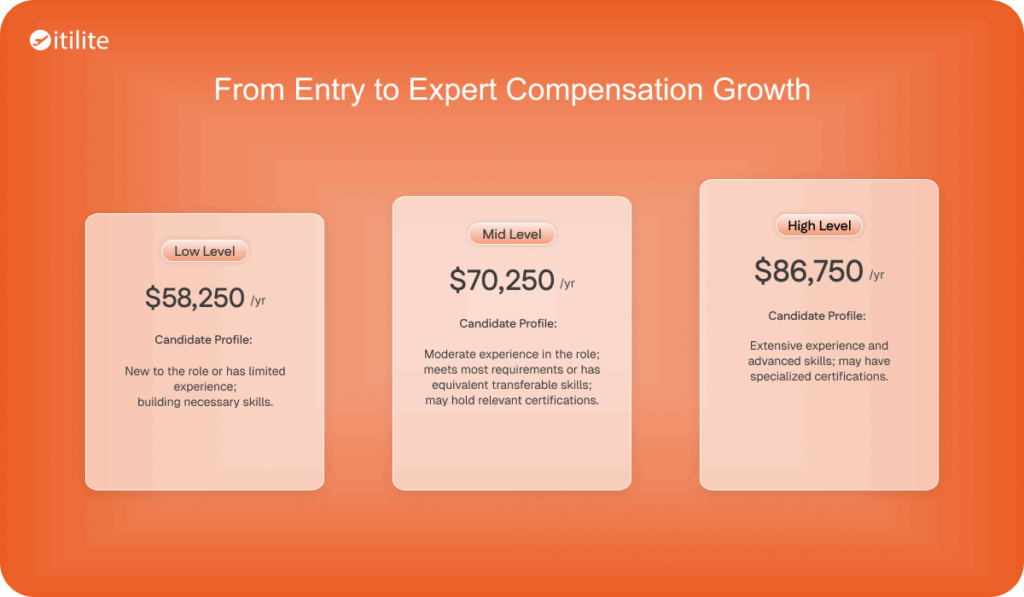
Compensation varies significantly depending on industry, company size, and location.
| Category | Level / Type | Salary Range |
| By Experience Level | Entry-Level EA (2–4 years) | $55,000–$70,000 |
| Mid-Level EA (4–8 years) | $70,000–$90,000 | |
| Senior Executive Assistant | $90,000–$120,000+ | |
| Executive Business Partner / Strategic EA | $120,000–$160,000+ | |
| Major Markets (NYC, SF, Boston, LA, DC) | +15–30% above national averages | |
| By Industry | Technology | $85,000–$140,000 |
| Finance & Private Equity | $95,000–$150,000 | |
| Healthcare | $70,000–$105,000 | |
| Legal | $75,000–$115,000 | |
| Nonprofit | $55,000–$85,000 | |
| Manufacturing | $65,000–$95,000 | |
| By Company Size | Startup (Under 50 employees) | $65,000–$95,000 |
| Mid-size company (50–500 employees) | $75,000–$110,000 | |
| Large enterprise / Fortune 500 | $90,000–$140,000+ |
Source: Glassdoor, 2026
Tools That Make an Executive Assistant's Job Significantly Easier
The Executive Assistant role has always required juggling a dozen things at once. But there is a difference between complexity that challenges you and complexity that just wastes your time. The right tools eliminate the second kind entirely.
Instead of looking for one "Executive Assistant super app," map your tools to the responsibility buckets that drain your time the most. Here are the three that matter most and the tools worth knowing for each.
Travel and Logistics → ITILITE
Picture a typical week. Your executive has a board meeting in New York, a client dinner in Chicago, and a leadership offsite in three weeks involving eight people, four cities, and a budget finance is already asking about.
Managing that across multiple booking platforms, a shared spreadsheet, and a WhatsApp thread is exactly as exhausting as it sounds.
ITILITE's corporate travel solution for executive assistants brings travel booking, expense management, and corporate cards into one platform. Policies enforce automatically at the point of booking. Expense reports generate from trip data instead of blank forms. Card transactions reconcile without you chasing receipts. And for offsites, group bookings, approvals, and budgets all live in one place instead of twelve email threads.
That last part matters more than it sounds. Offsites sit at the intersection of travel, calendar management, budget oversight, and stakeholder coordination, all at once. One tool handling the travel and expense layer is the difference between a Monday morning firefighting and a Monday morning actually prepared.
Meeting Management → Otter.ai
Every meeting generates work before and after. Multiply that across a full executive calendar and meeting management quietly consumes your day.
Otter.ai records, transcribes, and summarizes meetings across Zoom, Google Meet, and Teams — and pulls out action items automatically. What you do with that summary still requires you. The transcription part no longer does. Free tier works for light use; paid plans from $10/month.
Workspace and Systems → Notion
If you were unavailable tomorrow, could someone find everything they needed in ten minutes? If the answer involves "it's in the email thread" - that's not a system, that's a single point of failure.
Notion connects everything: executive dashboards, briefing templates, travel trackers, meeting checklists, project boards. Build a template once, replicate it forever. Free tier is solid; $10/month unlocks full version history worth having once you're sharing with the exec team.
Executive Assistant Traditional Job Description
Most job postings for this role still read something like this:
We are looking for a detail-oriented Executive Assistant to support our leadership team. Responsibilities include managing calendars, scheduling meetings, booking travel arrangements, handling correspondence, and performing general administrative duties. The ideal candidate has strong organizational skills, excellent communication abilities, and proficiency in Microsoft Office.
Recognizable? Of course it is. You have seen this exact description or a version of it, on every job board for the last decade.
Here is what it does not tell you: the strategic layer, the relationship management, the AI orchestration, the judgment calls made daily without a playbook, and the reality that this role has quietly become one of the most complex in any organization.
This is what an Executive Assistant job description in 2026 should actually look like instead.
A Final Note for Executive Assistants Reading This
ITILITE have interacted with Executive Assistants for years and worked to solve their travel-related problems. Through these experiences, we gained a deep understanding of the roles and responsibilities of Executive Assistants.
(Interestingly, the NAIS 2024 Survey on Executive and Administrative Assistants found that 82% of Executive Assistants share similar core responsibilities, which means if you recognize yourself in what this article describes, you are exactly who this role is built for.)
The future of the Executive Assistant role is strategic and growing. Embrace AI with confidence, automate the operational noise, and focus on the work that increases your value.
Streamline travel and expenses with smarter tools like ITILITE and spend your time building a career, not chasing receipts.
FAQ
1. What is the main thing I am there to do as an Executive Assistant?
Make your executive more effective. Everything else, the calendar, the travel, the inbox, the stakeholder management, is in service of that one outcome. The role is fundamentally about organizational leverage.
2. What skills do I need to land an executive assistant role?
Hiring managers consistently prioritize discretion, communication, and the ability to manage ambiguity, the judgment to act without a playbook. On the technical side, calendar and travel management are table stakes; proficiency with productivity tools like Notion, and increasingly AI tools, is becoming a differentiator in competitive hiring processes.
3. What are the top 3 skills I need as an executive assistant?
Anticipation, communication, and discretion. Anticipation means solving problems before your executive knows they exist. Communication means writing on behalf of C-suite leadership without oversight. Discretion means handling sensitive information with integrity that never wavers.
4. What roles will I be expected to play as an executive assistant?
Your role spans four layers — operational (calendars, travel, expenses), strategic (briefings, project coordination), relational (stakeholder management), and increasingly in 2026, AI orchestration (automating repeatable work so your focus stays on higher-value decisions).
5. Is an executive assistant higher than an office manager?
They are parallel roles, not a hierarchy. An office manager keeps the organization running, facilities, vendors, admin systems. An EA operates inside the executive's decision-making process with higher confidentiality and strategic involvement.
6. What are the most common responsibilities I'll have as an EA?
Calendar management, travel coordination, expense reporting, drafting executive communications, meeting preparation, and stakeholder liaison. Senior roles add board prep, investor communications, and managing junior admin staff.
7. What should I put on my executive assistant resume?
Lead with impact, not duties. "Managed a 40+ meeting weekly calendar and coordinated travel across 12 countries" lands harder than "responsible for calendar management." Include AI tools you use confidently, it signals you are current. Add certifications like the Certified Administrative Professional (CAP).
8. What interview questions should I prepare for as an EA candidate?
Prepare for: How would you manage my day with seven meetings, three deliverables, and a last-minute crisis simultaneously? And in 2026 specifically: Which AI tools have you used and what for? These reveal anticipation and independence, the qualities that actually get you hired.
9. What's the salary range for an executive assistant?
It depends on seniority, industry, and company size. Entry-level starts at $55,000–$70,000, mid-level runs $70,000–$90,000, senior EA roles reach $90,000–$120,000+, and Executive Business Partners can hit $120,000–$160,000+. Industry matters too - finance and PE average $95,000–$150,000, tech $85,000–$140,000, legal $75,000–$115,000. One thing worth knowing if you are job searching right now: remote EA positions have increased 25% year-over-year. Large company remote roles frequently pay at the higher end of the range, location is no longer the ceiling it used to be.

I’ll be honest: I haven’t spent my life living out of a suitcase for business, but I’ve spent it obsessing over the systems of those who do. At ITILITE, I bridge that gap through relentless, intentional research. I dig deep into the data so the insights reaching you aren’t just SaaS noise. If you want to share your travel experiences or talk shop about expenses, find me on LinkedIn.



Control Costs, streamline travel with 24/7 support.
A fully integrated corporate travel management software that dramatically reduces spends while improving user experience