8 Best Egencia Alternatives in 2026 (Compared)
%20(1).avif)

Snapshot

- SaaS-led alternatives (ITILITE, Navan, TravelPerk) replace Egencia's evolving managed-platform model with self-serve software plus unified expense and corporate card workflows. ITILITE leads this group for mid-market US buyers (100–1,000 employees; 50–500 travelers) seeking platform consolidation.
- Mega-TMC alternatives (BCD, FCM, CTM) keep the managed-service operating model Egencia uses but at larger scale and more aggressive program management
- SAP Concur is the natural up-market software path for Egencia customers running multi-entity global compliance programs
- The most common reasons for switching: post-acquisition product roadmap slowdown, renewal pricing climbing as Amex GBT consolidates the platform, and the desire to consolidate travel with expense and corporate cards on one tool
- Realistic migration timeline: 2 to 6 weeks for SaaS alternatives, 8 to 16 weeks for managed-service alternatives, 4 to 6 months for enterprise software like Concur
Egencia spent the 2010s as one of the original SaaS travel management companies, then American Express Global Business Travel acquired it in 2021. The product still operates under the Egencia brand, but customers we hear from in 2026 describe a meaningful change in feel: less independent roadmap velocity, more integration into the broader Amex GBT supplier network, and pricing that has climbed since the acquisition.
If you're a current Egencia customer evaluating where to go next, the answer depends on what specifically isn't working. The 8 alternatives below cover three categories Egencia customers most often shortlist: SaaS-led platforms (faster rollout, unified T&E workflows, modern UX), mega-TMC managed services (more depth than Egencia, less SaaS-y than Navan), and the technology-infrastructure path (Spotnana, for tech-led travel programs).
At-a-glance comparison
Why Egencia customers leave (and what fits each reason)
Egencia migrations cluster around three patterns. Each pattern points at a different group on the list above.
- Reason 1: The post-acquisition product slowdown: Egencia's independent roadmap velocity slowed after the Amex GBT acquisition. Customers expecting the 2018-era SaaS pace of new features report waiting longer for product investment. If this is your issue, the SaaS-led alternatives (ITILITE, Navan, TravelPerk) ship faster and pair travel with expense and corporate cards on one platform rather than treating travel in isolation.
- Reason 2: Pricing climbing through renewal cycles: Amex GBT's consolidation of the platform has produced renewal increases for some Egencia customers. If cost is the issue, the unified SaaS pricing models (ITILITE at $10 per trip or $7 via pre-paid wallet, plus $6 per active user per month for expense; Navan with a free tier under 300 employees) often produce predictable per-trip or per-user economics versus the transaction-fee-plus-management-fee model Egencia uses.
- Reason 3: Outgrowing or undergrowing the mid-market managed model: Large enterprises with 5,000+ travelers tend to outgrow Egencia into BCD, FCM, CTM, or Amex GBT direct. Smaller programs (200 to 500 travelers) often find SaaS-led options like ITILITE more cost-effective and faster to roll out. Egencia's sweet spot has narrowed.
A travel program manager at a mid-market services firm we work with described it this way:
"Egencia was great when they were the modern SaaS option. Now they feel like just another managed TMC, except more expensive than they used to be. We ended up evaluating ITILITE and Navan in parallel. The unified platform consideration was the deciding factor."
SaaS TMCs (modern, unified, faster rollout)
1. ITILITE
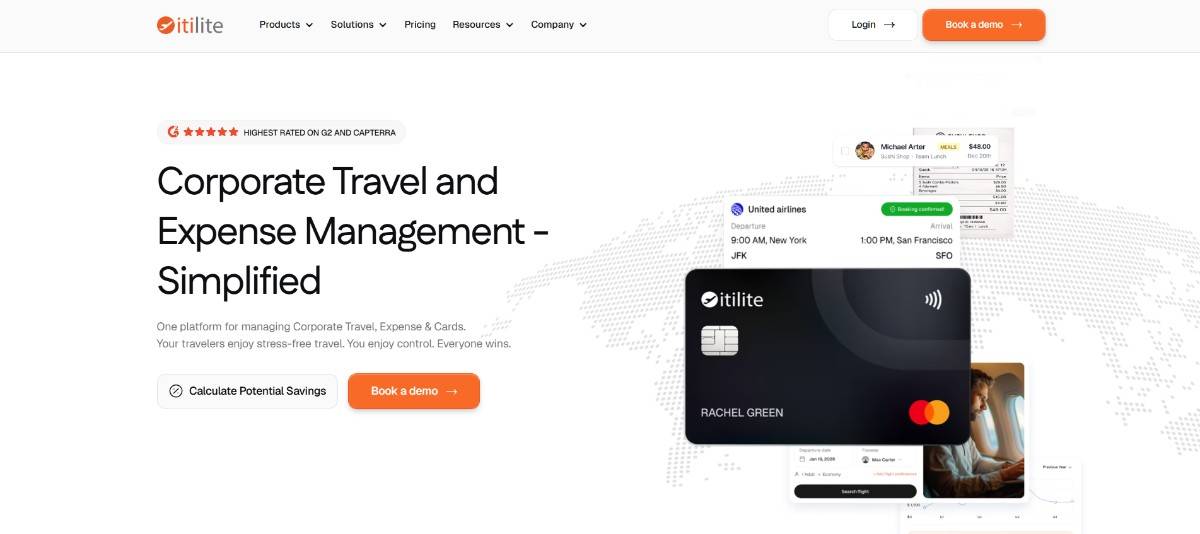
ITILITE is the most direct evolution of what Egencia originally tried to be: a SaaS-led travel platform with deep integration into the rest of the finance stack. Where Egencia stalled out after the 2021 acquisition, ITILITE has continued building. The platform unifies booking, expense reporting, and corporate cards on a single interface, eliminating the multi-vendor reconciliation work Egencia customers know all too well.
What makes the comparison particularly clean: ITILITE's travel pricing model is per-trip ($10, or $7 via pre-paid wallet), not transaction-fee based. For Egencia customers who have watched their renewal pricing climb as Amex GBT consolidates costs, the predictable per-trip economics matter.
Key capabilities
- Online booking with managed air and hotel inventory at competitive negotiated rates
- Per-trip virtual cards eliminating hotel CCA form payment fraud entirely
- Direct ERP connectors to NetSuite, QuickBooks, Sage Intacct, and HRIS via Workday
- Multi-region traveler support available around the clock
Where it fits: Mid-market US companies (100–1,000 employees; 50–500 travelers) running Egencia today plus a separate expense vendor (Concur, Certify, Expensify) plus a bank corporate card program. The structural change is collapsing those three relationships into one.
Cost: Flat $10-per-trip travel pricing (discounted to $7 via pre-paid wallet).
2. Navan
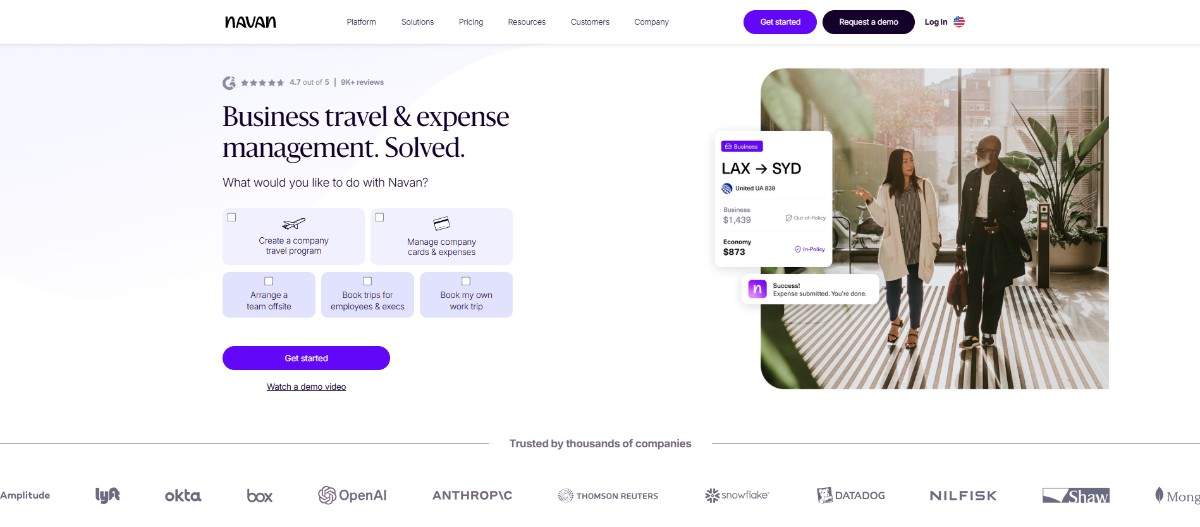
Navan competes for Egencia customers on the dimension Egencia has historically been strong on but no longer dominates: traveler experience. Egencia's online booking tool was best-in-class in the early 2010s; Navan's app has been best-in-class for the past several years. For Egencia customers whose travelers have been quietly drifting to Expedia or Booking.com because the corporate flow feels stale, Navan directly addresses that gap.
The free tier covering programs up to 200 active users gives Egencia customers a low-friction pilot path.
Key capabilities
- Highest-rated traveler mobile app in the corporate travel category
- Virtual and physical corporate cards with per-employee merchant restrictions
- Liquid travel rewards earned by booking under policy
- Around-the-clock support delivered first through in-app chat with phone escalation
Where it fits: Technology and professional-services companies in the US mid-market where the recurring Egencia complaint has been booking-tool stagnation.
Cost: Free for the first 200 active users.
3. TravelPerk

TravelPerk emerged from Barcelona and is now the SaaS TMC with the strongest European supplier and rail integrations. Egencia traditionally covered Europe through Expedia's inventory and now through Amex GBT's network, but TravelPerk's locally-built European footprint typically beats both on regional supplier depth and on intra-Europe rail bookings.
The signature feature is FlexiPerk. For a small per-trip premium, the cardholder can cancel any booking for any reason and recover around 80 percent of the cost, including on otherwise non-refundable flights. For programs with frequently-changing plans, this single feature often pays for itself within two months.
Key capabilities
- One interface for flights, hotels, rail, and ground transport
- FlexiPerk universal cancel-and-recover option
- GreenPerk emissions reporting and offsetting
- Plan-tiered support with chat as the entry channel
Where it fits: US mid-market companies with European travel volume or European subsidiaries; programs that value cancellation flexibility above negotiated airline rates.
Cost: Free at the lowest tier; usage-based pricing escalates with company travel volume.
Enterprise software
4. SAP Concur

For Egencia customers who don't want to leave the managed-service-plus-software hybrid model but feel Egencia has lost its edge, SAP Concur is the established alternative. Concur sells the software (Concur Travel + Concur Expense + Concur Invoice), and fulfillment runs through a partner network of regional TMCs rather than direct.
The strongest reason to consider Concur over Egencia: ERP integration depth. If you're already running SAP S/4HANA or Oracle ERP Cloud, Concur's native connector depth saves months of integration work versus any alternative. The trade-off is implementation timeline (4 to 6 months for most rollouts versus 2 to 6 weeks for SaaS).
Where it fits: Large enterprises on SAP or Oracle ERP. Multi-entity global compliance programs where Concur's policy depth justifies the longer implementation.
Cost: Custom quote.
Mega-TMC managed services
5. BCD Travel
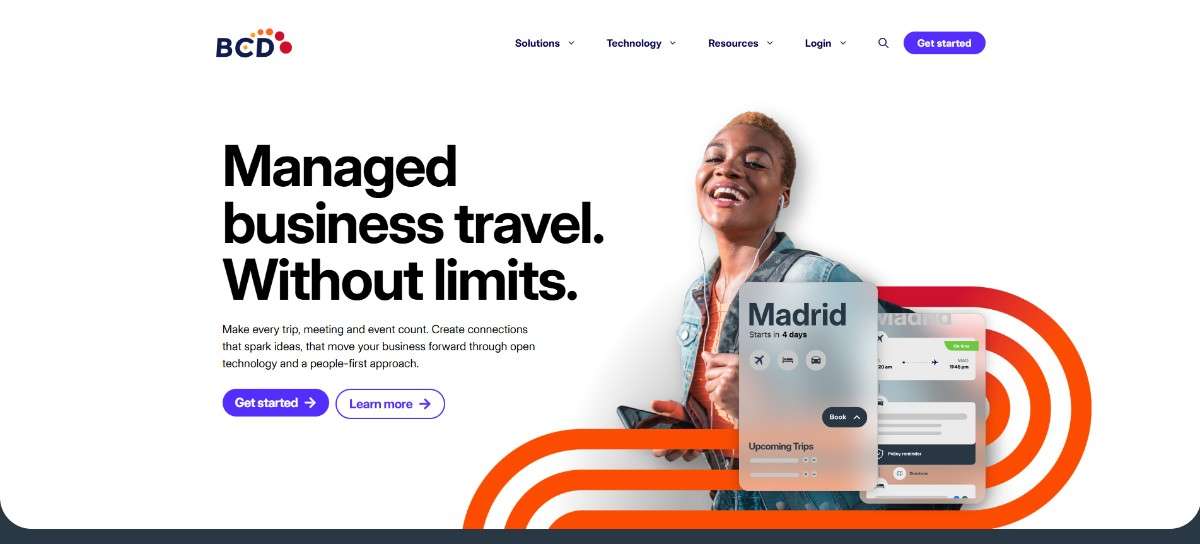
BCD is one of the historic Big Three TMCs (alongside Amex GBT and CWT), employee-owned, operating across 100+ countries with deep category-management expertise. For Egencia customers outgrowing the mid-market platform into complex global programs, BCD is one of the natural up-market moves.
What BCD does that Egencia struggles with at scale: program optimization analytics, airline RFP support, hotel program negotiation, savings benchmarks. Mid-market managed TMCs typically don't have the consultant depth to run these workflows at the level BCD does.
Where it fits: Large enterprises (5,000+ travelers across 30+ countries) with travel manager teams using analytics for category management.
Cost: Custom quote, transaction fee plus management fee.
6. FCM Travel
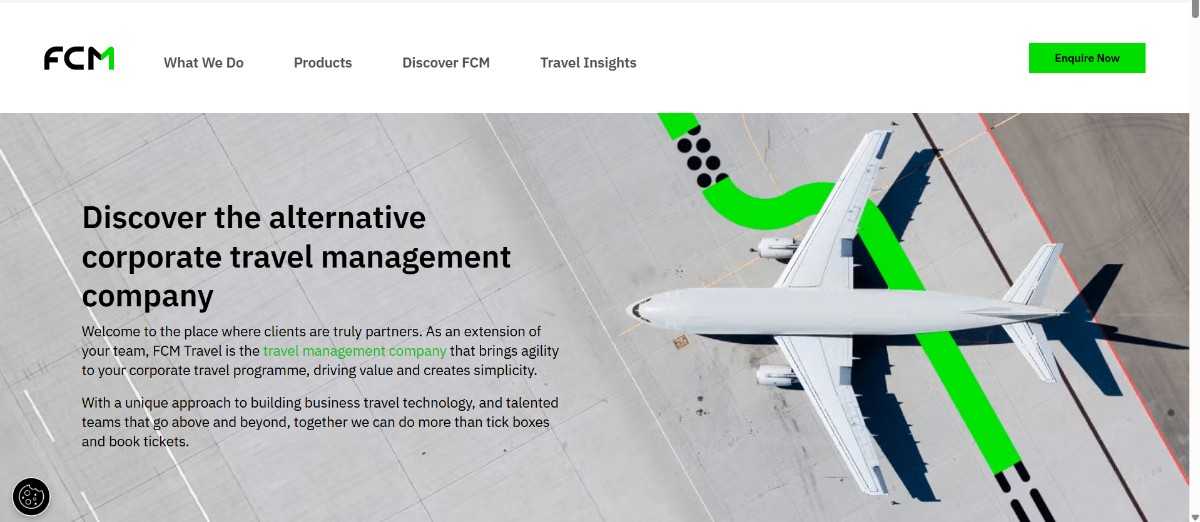
FCM is the corporate arm of Flight Centre Travel Group, with particular strength in the Asia-Pacific region and a rapidly growing North American business. FCM stands out among managed TMCs for its proprietary Sam:] AI travel assistant and Hub:] booking-and-expense platform, which give the product more software-product feel than typical managed-service competitors.
For Egencia customers running mid-to-large programs with APAC operations specifically, FCM's local capability beats what Amex GBT delivers through Egencia for that region. For US-only programs, the FCM-versus-Egencia decision is closer.
Where it fits: Mid-to-large enterprise programs with meaningful APAC travel or multi-country complexity beyond what Egencia covers cleanly.
Cost: Custom quote with the standard managed-service fee structure.
7. Corporate Travel Management (CTM)
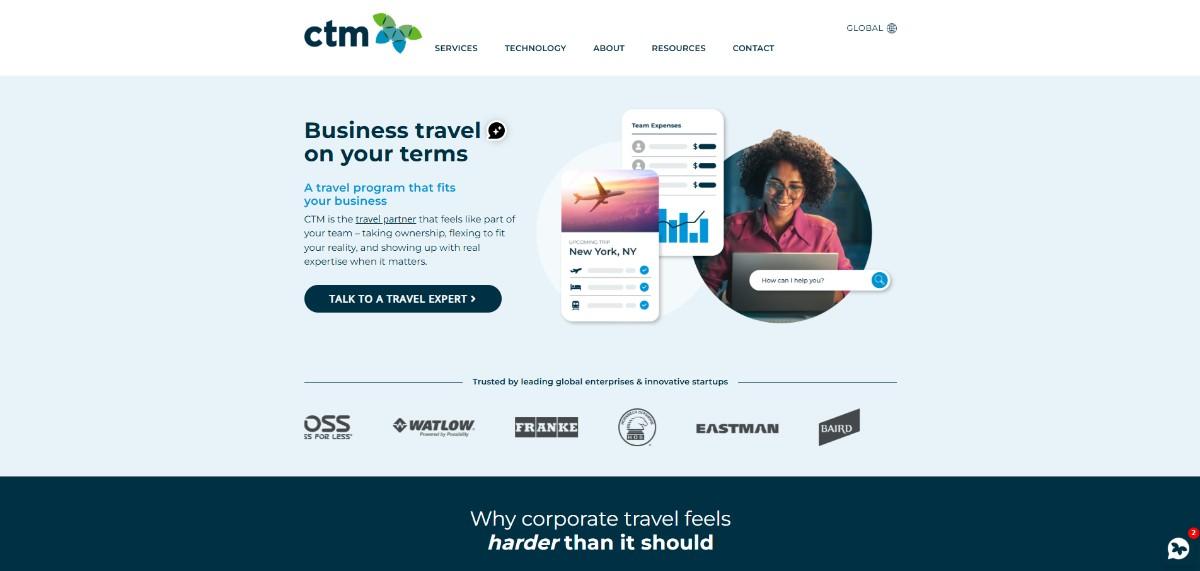
CTM is publicly traded on the Australian Securities Exchange and reached top-six global TMC status by managed spend through aggressive acquisitions, including Travel & Transport in 2020. The company carries an unusual niche specialization in government and not-for-profit travel programs alongside standard corporate work.
For Egencia customers leaving over service-tier concerns, CTM is the peer pick that competes specifically on named-account-team continuity and the financial transparency of an ASX-listed public company.
Where it fits: Mid-to-large enterprises in North America, APAC, and EMEA wanting a peer-scale managed service alternative with stronger named-account stability than other mid-market TMCs typically offer.
Cost: Custom quote, transaction-based pricing.
The infrastructure play
8. Spotnana
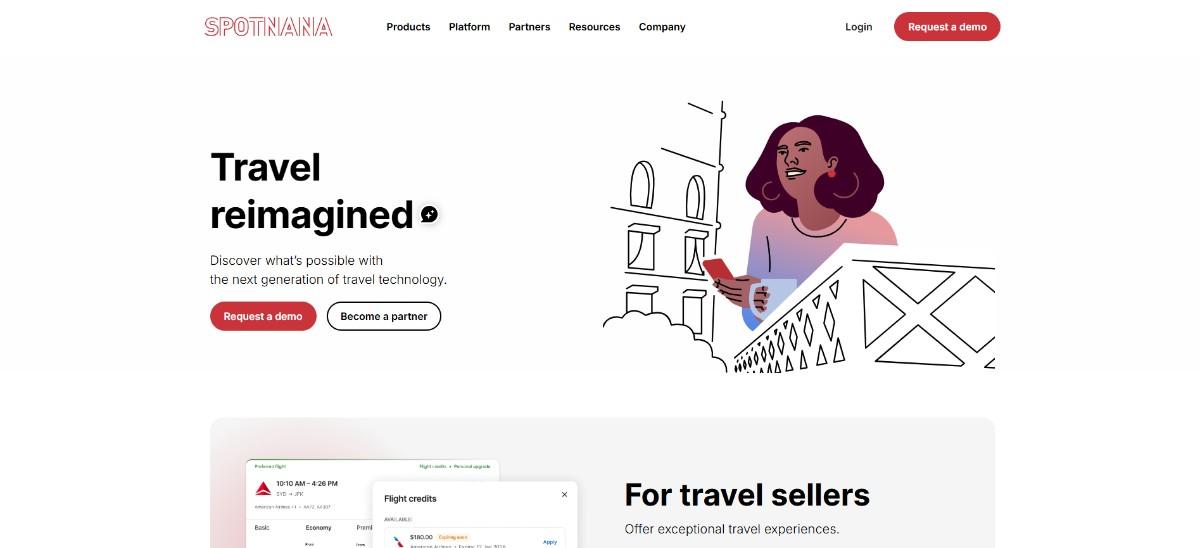
Spotnana is a modern TMC infrastructure platform that powers other travel programs (including Expensify Travel, some BCD deployments, and several SaaS TMC products) rather than typically being sold direct. For tech-led travel programs willing to build on TMC infrastructure rather than buying a finished product, Spotnana is the option.
Most Egencia customers won't engage Spotnana directly. They'll encounter it indirectly through one of the SaaS TMCs that runs on top of it. But for in-house engineering teams building custom corporate travel experiences (large enterprises with bespoke requirements), Spotnana is the infrastructure layer.
Where it fits: Tech-led enterprise travel programs building custom booking experiences on top of TMC infrastructure.
Cost: Platform pricing, custom.
So which one?
The migration target depends on what you're actually solving for. Three clean answers cover most Egencia migration patterns.
- You want unified travel-expense-card on one platform: Pick a SaaS TMC. ITILITE fits best for US mid-market wanting platform consolidation with per-trip pricing. Navan fits if traveler app experience is the priority. TravelPerk if European travel is a meaningful share of program volume.
- You want a stronger managed-service tier than Egencia delivers post-acquisition: BCD for the largest enterprise programs needing category-management depth. FCM for APAC-heavy or multi-country mid-to-large programs. CTM for peer-level managed service with stronger account-team continuity.
- You want enterprise software with depth Egencia doesn't match: SAP Concur is the move, especially if you're on SAP or Oracle ERP. Worth noting: Concur's TMC partner network may include vendors you already work with, which softens the transition.
Most Egencia customers we hear from end up evaluating ITILITE and Navan as the SaaS pair, plus one or two mega-TMCs (BCD, FCM, or Concur) as the managed-service comparison. The decision typically comes down to whether you want SaaS-style pricing predictability or managed-service-style depth, which is the same question Egencia tried to answer ten years ago before the acquisition.
FAQ
Why are companies leaving Egencia in 2026?
Three reasons dominate: the post-Amex-GBT-acquisition product roadmap has slowed compared to the SaaS pace Egencia maintained pre-2021; renewal pricing has climbed as Amex GBT consolidates platform costs; and customers wanting to unify travel with expense and corporate cards find Egencia treats travel in isolation while modern SaaS TMCs like ITILITE bundle the three workflows.
Is Egencia still independent or is it Amex GBT now?
Egencia operates under its own brand but is owned by American Express Global Business Travel as of 2021. The product roadmap, supplier negotiations, and pricing are increasingly aligned with Amex GBT's broader platform strategy. Customers experience this as integration depth gains plus product roadmap velocity losses.
What's the closest direct alternative to Egencia?
For SaaS-style operations, ITILITE is the closest fit because it pairs the booking platform with expense and corporate cards on one interface, extending the platform model Egencia was built around in 2002. For managed-service operations at similar scale to Egencia today, CTM and FCM are the natural mid-market peers.
Will my migration from Egencia be disruptive?
The disruption level depends on where you're going. Moving to a SaaS-led TMC (ITILITE, Navan, TravelPerk) typically completes inside 6 weeks for SMB and mid-market customers, with minimal traveler friction during cutover. Moving to a managed-service alternative (BCD, FCM, CTM) runs 2 to 4 months because you're renegotiating contracts, transferring supplier rate access, and standing up a new account team. A Concur deployment, which adds the full software-and-TMC-partner-network stack, can take 4 to 6 months end to end.
Can I keep some Egencia services and switch the rest?
Yes, depending on how your contract is structured. Some Egencia customers split travel booking onto a new platform while keeping Amex GBT supplier-network negotiated rates active through a separate contract. This works best when you're moving to a SaaS TMC like ITILITE or Navan that can use existing supplier relationships rather than starting fresh.

Ardra is a Content Strategy Manager at ITILITE with 6+ years of experience in travel and SaaS content. She holds a Master’s degree in Political Science from Lady Shri Ram College for Women and transitioned from academic research and travel content into SaaS content strategy.
She previously worked with JustWravel, where she focused on travel storytelling and digital content. Today, she specializes in SEO and AEO-driven content strategies that help businesses simplify complex travel and expense workflows into search-optimized narratives.
When she’s not working, Ardra is usually reading or watching films.



Modernize more than just your travel program
A fully integrated corporate travel management software that dramatically reduces spends while improving user experience
.avif)

%20(1).avif)