How to Book Candidate Travel: Choosing the Right Tool in 2026
.avif)


TLDR;
- A candidate travel booking tool books flights and hotels for interviewees who have no login and no corporate card.
- Look for six things: no-app booking, company-paid virtual cards, candidate policy, managed support, central billing, and refunds to the company.
- Concur can book guests, but only through an arranger with a Guest Booking role and a card on file
- Candidate experience is a hiring lever: about 60% report a poor experience and 72% share it.
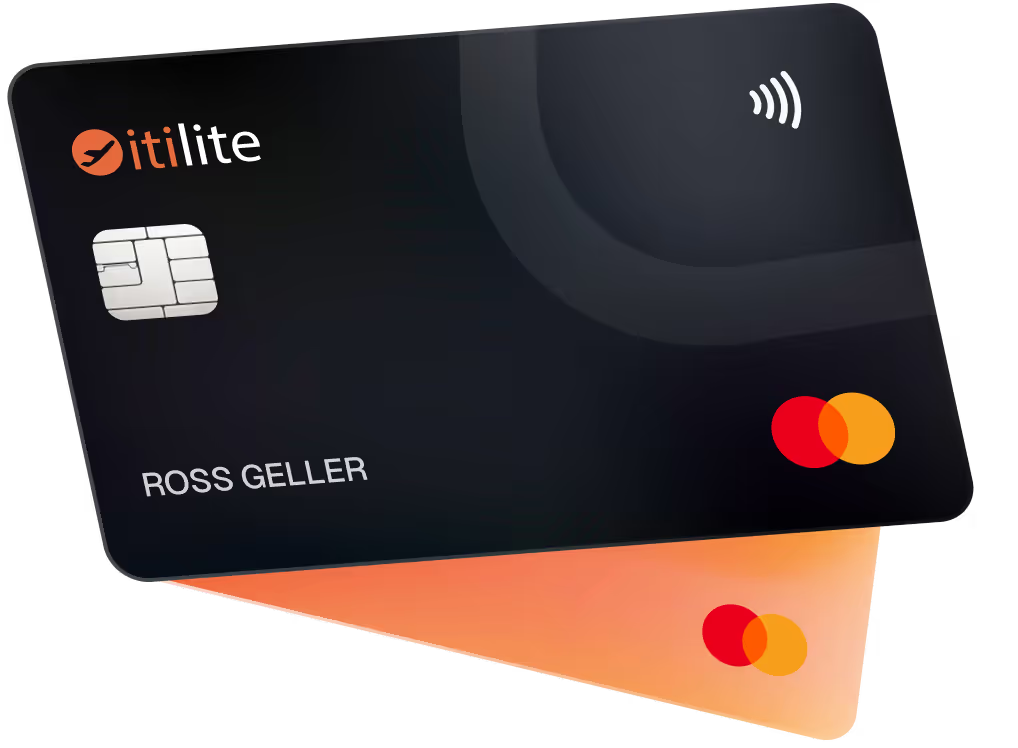
- ITILITE books candidate travel through a link, with no login for the candidate and a one-time virtual card.


If you are a recruiter/travel coordinator looking for a tool that books candidate travel the same way it books employee travel, you have come to the wrong place. Candidate travel breaks almost every assumption a corporate travel platform is built on. Considering candidates/interviewees are not employees, booking travel for them from the company side requires separate reconciliation and planning. As an HR/recruiter, you will be in charge of this travel process, which usually doesn’t fall within your bucket.
And that’s exactly why candidate travel in the corporate business world has remained a tricky problem to solve. When the traveler persona changes, the ownership persona also changes. That is the reality check you need to have before trying to solve candidate travel through a booking platform.
Let's break it down with real-world situation examples that ITILITE has faced while solving candidate booking.
What is a candidate travel booking tool, and how is it different from typical employee business travel?
A candidate travel booking tool books and pays for interview travel on the company's behalf for a person who does not exist in any of your systems. These travelers won’t have login IDs, employee IDs, saved cards, or access to create expense reports either.
These are your future employees, and this is the perfect opportunity to give them a glimpse of what your travel process looks like(First impression that's gonna last).
The category also trades under candidate travel platform, candidate travel solution, and candidate travel software, and all of them solve the same problem: flying in a stranger cleanly.
The traveler is a stranger to every system you own, and the trip doubles as a sales pitch. That combination is the whole problem. You have already spent an average of $5,475 to get a non-executive candidate this far. Asking them to float the flight on a personal card is a cheap way to undo it.
Employee travel assumes a profile but candidate travel has no profile to assume. That one difference cascades into six others.
- The traveler is unknown to every system you own: No HRIS record, no default cost center, no saved payment method, no policy tier that applies. Every field a booking flow expects to autofill has to be typed by someone.
- The lead time is short and the fares are high: Interviews take up to three to seven days out, which is the most expensive booking window in air travel. Employee trips rarely book that late by default.
- Candidates judge you on the trip: Your future employees form their first impression of the company from how the interview visit goes. A flight that gets rebooked twice becomes part of how they see you.
- Recruiters end up booking the travel: They collect the candidate's legal name and date of birth, compare flight options, book the hotel, redo all of it when the panel shifts, and answer questions over the weekend. That is hours of admin work sitting on top of a recruiter's actual job.
- You cannot recover the cost if the candidate declines: With an employee, an overspend gets handled through payroll or a conversation about policy. With a candidate who turns down the offer, the money is simply gone, and any airline credit stays in their name where your company cannot use it.
- The personal data is legally awkward: A flight booking needs the traveler's full name, date of birth, and gender for TSA Secure Flight watchlist matching. Collected by email, that puts a record of a candidate's age and gender in a hiring inbox before a decision is made. The EEOC's position is that asking for a date of birth is not automatically unlawful, but that it can serve as evidence of discriminatory selection.
Who pays for Candidate Travel Booking?
Two payment models exist for candidate travel, and they produce very different candidate experiences.
- Model one: the company pays directly, without the need of reimbursement : A one-time virtual card is issued for the trip, scoped to the amount, and charged to the company. The candidate spends nothing and files nothing. Exposure is capped at a single booking.
- Model two: the candidate fronts it and gets reimbursed: The candidate buys their own flight, pays for their own hotel, and submits receipts to a company they do not work for. That reimbursement has to route through accounts payable as a non-employee payment, because there is no payroll record to attach it to. The IRS treats interview-expense reimbursements to prospective employees under accountable plan rules, so documentation and timing requirements apply before the money is non-taxable.
- Model two is where the candidate experience goes wrong: Roughly 60% of candidates already report a poor hiring experience, and 72% of them tell someone about it.
- Model one has a failure mode too: Ground transport, checked bags, and meals rarely sit on the card, so the candidate still fronts the incidentals. Those need a reimbursement path that closes in days, not cycles.
Which is why the fix is not a better spreadsheet or a stricter policy. It is a system that owns the booking, the payment, and the cleanup end to end.
The 8 things to look for in a candidate travel booking tool
Eight capabilities separate a real candidate travel tool from a corporate travel platform with a guest option bolted on. Score any vendor against all eight before you buy, because the gaps only surface once a candidate is standing at a front desk or a recruiter is doing data entry at 8pm.
1. No app or login for the candidate
The candidate should book from a link, not an account. Creating a user profile triggers welcome emails, hands an outsider credentials, and blocks their real profile if they eventually join. Booking should take two minutes with no download and no password.
2. The company pays, the candidate never fronts costs
A one-time virtual card scoped to the trip means the candidate spends nothing and files nothing. The card carries a set amount and an expiry date, so your exposure is capped at a single booking. These are the same controls behind virtual cards in corporate travel, applied to someone who is not on your payroll.
3. The candidate never hands personal details to the recruiter
Booking a flight requires legal name, date of birth, and gender. Move those through a recruiter's inbox and protected-characteristic data is sitting in a hiring file before a decision is made. The candidate should enter their own travel details into the booking flow directly, where the recruiter never sees them and the record lives with the travel system rather than the hiring team.
4. Candidate-specific policy
Interviews move and cancel, so you want rules that apply only to candidates: refundable-only fares, fare caps by role, hotel radius from the office. The policy should ride with the booking link rather than a user profile, which is the same discipline set out in the travel and expense policy guide.
5. Self-serve changes backed by real human support
A candidate should be able to move their own flight when the panel shifts, and reach a person in seconds when they cannot. Support that routes every problem back to the recruiter is not support. Ask for a contracted response time and what happens when it is missed, as covered in the business travel support breakdown.
6. Centralized billing and reconciliation
Every candidate trip should land on one invoice and reconcile against the booking automatically, not arrive as personal-card receipts weeks later. Recruiting travel also needs to be tracked separately from employee travel so the cost lands against the requisition rather than a general T&E bucket.
7. Automated credit card authorization for hotel check-in
Hotels increasingly demand a signed authorization form before accepting a card they never physically see. A candidate travel platform should send the card to the property and confirm it on file before arrival, so the candidate walks up to the desk and gets a key. ITILITE handles this through its credit card authorization feature, where agents confirm the card with the property ahead of the stay.
8. Refunds and unused credits that return to the company
When a candidate cancels, the airline credit should return to the company account, not sit in a non-employee's name. Ask specifically whether credits pool at the company level and how they get applied to future bookings. This one detail is where improvised setups quietly lose money across a hiring year.
How to book candidate travel with ITILITE
ITILITE runs candidate travel on one link, a one-time virtual card, and an agent who calls the hotel before the candidate arrives. More than 100+ companies book guest and candidate travel on the platform. Here is what each step looks like in practice.
- The recruiter sends one link to the candidate. The candidate opens the link and books inside the policy you have already set.
- Or the recruiter keeps control: For teams that would rather not hand over the choice, a coordinator can search, shortlist options, and share them with the candidate to confirm. Hotels can stay fully concierge-managed while flights are self-booked, which is the split most recruiting teams actually want.
- Payment never touches the candidate: ITILITE issues a one-time virtual card for the exact amount of the booking. The candidate does not enter a card, does not see a card, and does not file an expense report. No corporate card number moves through email or a hotel fax.
- The hotel card is confirmed before check-in: ITILITE's agents send the virtual card to the property ahead of the stay and call to confirm it is on file. This kills the most common candidate travel failure, which is a finalist arguing with a front desk about a card the hotel cannot process. For why hotel authorizations fail in the first place, see the credit card authorization failed breakdown.
- Policy is set once, for candidates only: You write one set of rules that covers candidate trips and nothing else: refundable fares only, a fare cap that changes with the role, and hotels within a set distance of the office.
- Support answers in seconds: Candidates reach ITILITE’s human support directly instead of routing every question back to the recruiter, which is the difference between a coordinator's evening and a coordinator's evening off.
- Interviews get rescheduled and candidates withdraw: When that happens and you cancel the trip, the refund goes to the company account. It does not turn into an airline credit sitting in the candidate's name that nobody at your company can use.
The full capability set sits on the candidate and guest travel page. If you also book speakers, board members, contractors, and clients, the wider non-employee setup is covered in the guest travel platform guide.
Candidate travel policy: the four rules that matter most
Most travel policies cover employees and stop there, which leaves recruiters improvising. Four rules handle the majority of candidate travel decisions.
FAQ
How do I book travel for a job candidate?
Send the candidate a booking link from a candidate travel booking tool. They book compliant flights and hotels with no login, a one-time virtual card pays for the trip, and the tool confirms the hotel card before check-in. The candidate never fronts costs or files an expense report.
Who pays for candidate travel?
The company does, through a one-time virtual card issued for the trip. Scoping the card to a single booking caps the spend and means the candidate spends nothing. Reimbursing a candidate afterward routes through accounts payable as a non-employee payment and takes far longer.
Can a candidate book their own travel without a login?
Yes, with a link-based candidate travel platform. The candidate opens a link, picks from options that already fit your policy, and books. No account, no app, no password. Tools that require a profile also send welcome emails and create duplicate records if the candidate later joins.
What happens to the airline credit if a candidate declines the offer?
That depends on how the ticket was booked. Book refundable fares for candidates and the value returns to the company account. Book non-refundable and the credit is issued in the candidate's name, where you can neither transfer it nor bill against it.
Should candidates give their date of birth and ID details to the recruiter?
No. Flight bookings need legal name, date of birth, and gender, and none of that should sit in a hiring inbox before a decision is made. Use a candidate travel solution where the candidate enters their own details into the booking flow directly.
What is the best candidate travel booking tool?
The best tool books through a link with no candidate login, pays on a one-time virtual card, applies a candidate-only policy, confirms hotel authorizations before check-in, keeps personal data out of the recruiter's inbox, and credits refunds back to the company. ITILITE is built around those eight capabilities.

Ardra is a Content Strategy Manager at ITILITE with 6+ years of experience in travel and SaaS content. She holds a Master’s degree in Political Science from Lady Shri Ram College for Women and transitioned from academic research and travel content into SaaS content strategy.
She previously worked with JustWravel, where she focused on travel storytelling and digital content. Today, she specializes in SEO and AEO-driven content strategies that help businesses simplify complex travel and expense workflows into search-optimized narratives.
When she’s not working, Ardra is usually reading or watching films.
Book candidate travel without the back and forth
A fully integrated corporate travel management software that dramatically reduces spends while improving user experience