

Best Business Credit Cards for Travel in 2026



TLDR;
- Premium travel rewards cards (Amex Business Platinum at $695/year, Chase Sapphire Reserve Business at $795/year) earn back their annual fees through travel credits, lounge access, and points transfers for businesses that travel 8+ trips a year
- Mid-tier travel cards (Chase Ink Business Preferred at $95/year, Capital One Spark Miles at $0 first year then $95) deliver 80% of the rewards value at a fraction of the annual fee
- SaaS corporate cards (ITILITE, Ramp, Brex) underwrite on business cash flow rather than personal credit, typically waive personal guarantee, and bundle expense automation with the card
- For travel-heavy programs, the highest-ROI combination is often a premium rewards card for personal-and-reimbursed travel plus a SaaS card for company-paid travel and centralized expense control


Most "best business credit card for travel" articles do something dishonest. They lump SaaS corporate cards (Ramp, Brex, ITILITE) into the same ranked list as Amex Platinum and Chase Sapphire Reserve and act like they compete on the same terms. They don't. Traditional travel cards exist to maximize points and perks. SaaS corporate cards exist to control spend and ship instantly. If you pick one when you needed the other, the annual fee math turns ugly fast. So here's the honest version. Ten cards, split into two groups. Pick the group first. The card within the group is the easier decision.
The 10 cards at a glance
Traditional travel rewards cards are for cardholders who want points, transfer partners, and travel perks.
SaaS corporate cards are for finance teams who want spend control and expense automation, not travel rewards.
How to pick the group
Three quick filters. If your answer to all three lines up with one group, that's your group.
- Do you want points or spend control? Traditional cards optimize for points value. SaaS cards optimize for control over where the money goes. You can't have both in one card.
- Are you OK with a personal guarantee? Almost every traditional business card requires the cardholder to personally guarantee the debt. Brex, Ramp, and ITILITE typically waive this for businesses that qualify on cash flow or VC funding. If a PG is a non-starter, you're looking at SaaS.
- How fast do you need the card? Traditional issuers take days to weeks. SaaS issues virtual cards in minutes. For a sales hire who starts Monday with a customer dinner already booked, SaaS wins.
A founder we work with put it simply: "We use Brex for the company spend that should not touch my personal credit. We use Chase Sapphire Reserve Business for the trips where I want the Hyatt points. They're not the same problem."
Traditional travel rewards cards
Traditional travel rewards cards are built for maximizing value from travel spend. The more your team flies, stays at hotels, and books directly with airlines, the more these cards return through points multipliers, lounge access, statement credits, and transfer partners. The tradeoff is that most require a personal guarantee and expect the cardholder to actively optimize bookings and rewards to justify the annual fee.
1. American Express Business Platinum
The Business Platinum is what you carry if business travel is a meaningful part of your year. Five times Membership Rewards points on flights and prepaid hotels through Amex Travel. Centurion Lounge access plus Priority Pass Select. Global Entry credits, airline fee credits, Dell credits, Indeed credits. The annual fee is $695, which is high until the credits stack up. Most cardholders who actually use Dell and Indeed pull the net cost close to zero.
- The catch: The rewards work best when you book through Amex Travel. Direct bookings earn 1.5x, not 5x. If your travelers book on airline sites or Expedia instead of Amex Travel, the points math doesn't carry the fee.
- Best for: Founders, executives, and sales leaders who actually use Amex Travel and take 10+ trips a year.
2. Chase Sapphire Reserve for Business
The Sapphire Reserve Business launched in 2024 and went directly at the Amex Platinum's premium positioning. The annual fee is $795, the highest in the segment, and the rewards rate is also the highest: 8x Ultimate Rewards on Chase Travel, 3x on direct travel and dining.
What makes it work is the Chase transfer ecosystem. Ultimate Rewards points convert 1:1 to Hyatt and United, which are the two transfer partners business travelers actually use. A 100,000-point transfer to Hyatt can produce $2,000 to $3,500 in luxury hotel value at properties where Hyatt's award rates are well below the cash rate. No flat-cashback card competes with that math.
The Sapphire Lounge by The Club access is the new perk in 2024-2026. It's smaller than Centurion but spreading to more airports.
- Best for: Travelers who book directly with airlines and hotels, want Hyatt transfers, and are at airports where Sapphire Lounges exist.
3. Capital One Venture X Business
The Venture X Business is the easy answer when you don't want to think about categories. It pays 2x miles on every purchase, period. Plus 10x on hotels and 5x on flights when booked through Capital One Travel. The $395 annual fee comes with a $300 Capital One Travel credit, which most travel-card-holding businesses use, putting net cost around $95 a year.
No foreign transaction fees. Priority Pass plus Capital One Lounge access (currently at IAD, DFW, DEN, LAS, MSP, with more rolling out). Miles transfer to 15+ airline and hotel partners.
This is the card we recommend to people who don't want to optimize. Carry it, swipe it, the math works out.
- Best for: Cardholders who travel a moderate amount, want flat-rate value, and travel internationally enough that the no-FTF matters.
4. American Express Business Gold
Gold's structure is interesting. Every billing cycle, Amex looks at where the cardholder spent in 6 eligible categories (transit, airfare, U.S. media, U.S. restaurants, U.S. office supplies, U.S. gas, electronic goods) and pays 4x Membership Rewards on the top 2 of those 6. The cap is $150,000 combined across both top categories per year.
If your spend genuinely concentrates in 2-3 of those categories every month, Business Gold can outearn flat-rate cards by a wide margin. If your spend is diversified across 5-6 categories evenly, Capital One Venture X's flat 2x will produce more points net.
The $20 monthly wireless and restaurant credits ($240/year combined) cover most of the $375 annual fee for cardholders who use them.
- Best for: Predictable-spend businesses where 60%+ of card spend falls into 2-3 of Amex's eligible categories.
5. Chase Ink Business Preferred
The Ink Business Preferred at $95 is the value play, the card that produces 80% of premium-card value at one-eighth the fee. Three times Ultimate Rewards on every travel transaction (airlines, hotels, rental cars, taxis, parking, rideshare), plus 3x on shipping, telecom, and ads, up to $150K combined per year.
Two things make this card disproportionately good. First, the travel multiplier is real travel, not "Chase Travel only." Booking United directly earns 3x just like booking through Chase. Second, the trip cancellation, trip interruption, and primary auto rental coverage built in are not trivial: one canceled trip covered by the card typically saves more than the annual fee.
Same Ultimate Rewards transfer ecosystem as Sapphire Reserve. Same Hyatt math. Just $95 instead of $795.
- Best for: Anyone who doesn't travel enough to earn back a $700 annual fee but wants real travel rewards. Which is most small businesses.
6. Capital One Spark Miles
Spark Miles is for international business travel. Two times miles flat, no foreign transaction fees, transfers to 15+ airline programs including Aeroplan, Avios, and Wyndham. Annual fee waived the first year, $95 thereafter.
It's not the best for any specific scenario except one: a card you can swipe in Tokyo or São Paulo without paying the 3% surcharge that most other business cards add. For businesses doing meaningful international travel, the saved foreign transaction fees alone outweigh the eventual $95 annual fee.
- Best for: Cardholders with international travel volume, or as a no-FTF backup to a premium domestic card.
7. Bank of America Business Advantage Travel Rewards
The cheapest credible option in the travel category. No annual fee, 1.5 points per dollar on everything, 3 points on travel booked through BoA's Travel Center, no foreign transaction fees.
The interesting wrinkle is BoA's Preferred Rewards for Business multiplier. If the business already has BoA banking with a qualifying deposit balance, the card rewards rate increases by up to 75%. A business already on BoA can produce 2.625 points per dollar on travel, which competes with mid-tier paid cards while paying zero annual fee.
- Best for: Businesses already banking with BoA, or budget-conscious businesses that want a travel card but won't justify a paid annual fee.
SaaS corporate cards
These are a different category. Read the section above on how to pick the group before reading the entries here.
8. ITILITE Corporate Card
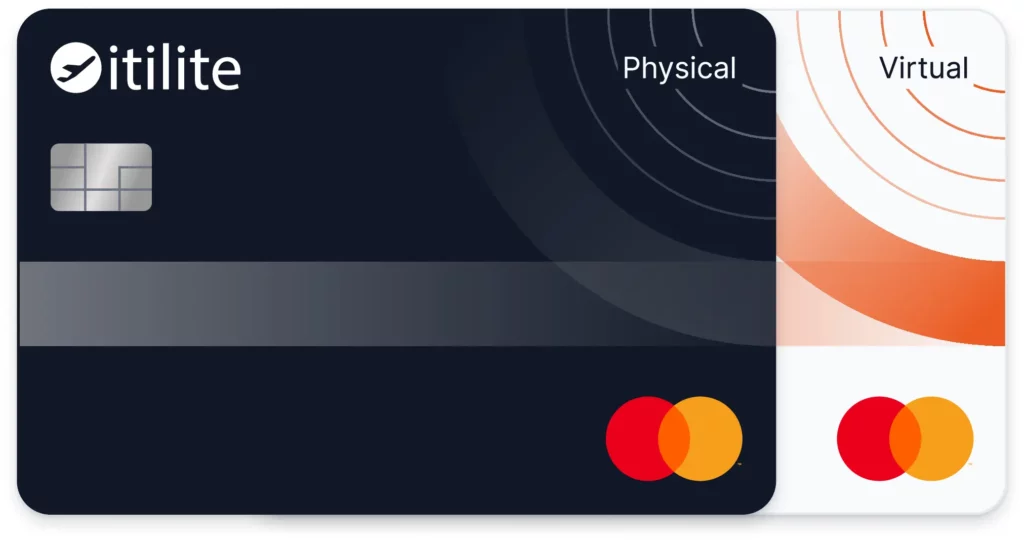
The ITILITE Corporate Card is part of the ITILITE travel and expense platform. The card isn't sold as a standalone product. It comes bundled with the booking, the expense workflow, and the approval rules, on one interface, at a flat $10 per trip.
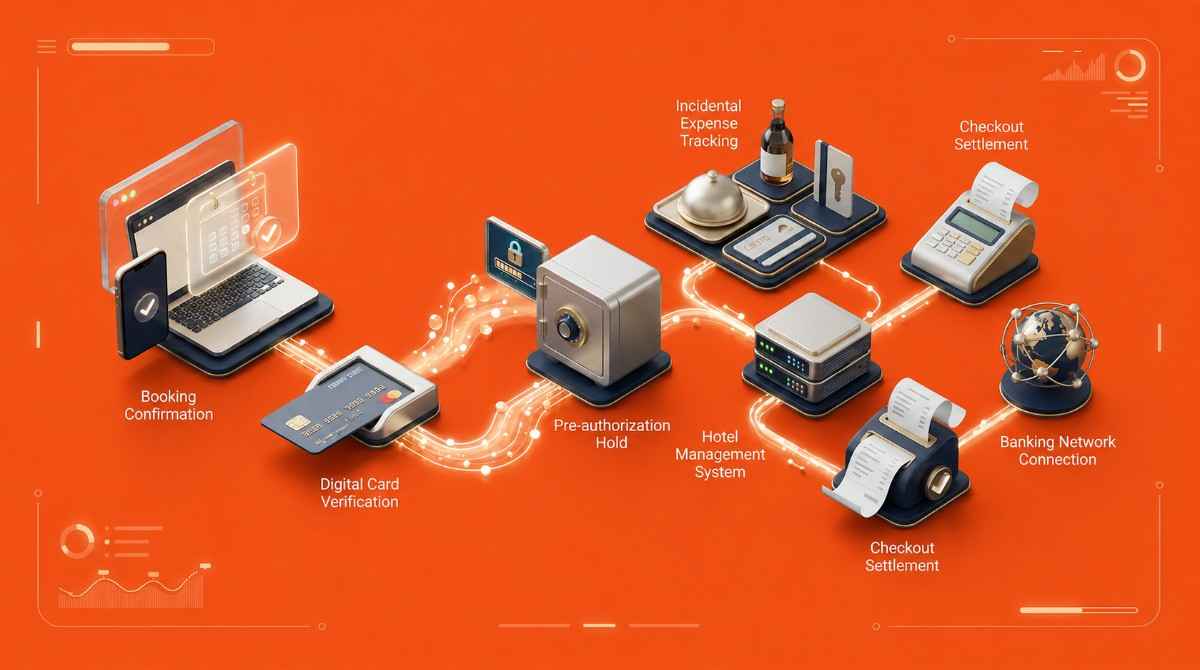
What makes this work for business travel specifically is the virtual card layer. When a traveler books a hotel through ITILITE, the platform issues a virtual card number capped at the booking amount and merchant-locked to the property. The hotel never sees the primary corporate card. Post-checkout charges outside the booking scope can't go through because the virtual card doesn't have authorization for them.
For finance teams that have been losing weeks to disputed post-stay charges from hotels, this is the structural fix. The cardholder doesn't have to remember to monitor; the architecture prevents the failure mode.
- Best for: Mid-market businesses (50 to 2,000 employees) where travel is meaningful spend and where the finance team wants travel, expense, and card on one platform.
9. Ramp Business
Ramp isn't a travel rewards card. It's a finance automation platform that issues a card. Travel earns 1.5% cashback, same as every other category. There's no travel-specific bonus, no transfer partners, no lounge access.
What Ramp does instead is everything that happens after the swipe. Receipts auto-capture. Expense reports auto-generate. The bill pay sits in the same dashboard. The AP team stops doing the work that used to take three hours a week.
For a business where travel is one expense category of many and where the finance team's biggest pain is administrative time, not unredeemed points, Ramp is the right pick. For a business where the founder cares about Hyatt nights, it isn't.
- Best for: SMBs and mid-market companies where the finance team's primary goal is automation, not travel optimization. Source: Ramp (https://ramp.com/pricing).
10. Brex Business
Brex's travel rewards stack is the strongest among SaaS corporate cards. Cardholders earn up to 7x points on rideshare, 4x on travel, 3x on dining, and 1x on everything else, conditional on the company committing to use Brex as its exclusive corporate card. Points transfer to Air France-KLM Flying Blue, JetBlue, and Marriott Bonvoy.
Two factors make Brex interesting beyond the rewards rate. First, the underwriting model: Brex uses cash on hand and funding history rather than personal credit, so VC-backed founders get a meaningful credit line without putting personal credit on the line. Second, the platform: Brex includes treasury services and the Brex Business Account, which means the card and the banking sit on the same dashboard for finance teams that want consolidation.
Where it doesn't work: bootstrapped or revenue-only businesses without VC funding may not qualify for the strongest Brex underwriting, and the exclusivity requirement on the bonus rewards is real. Using a different card for some spend triggers a lower base rate on Brex.
- Best for: VC-backed startups and funded mid-market companies with meaningful travel spend.
So which one?
Here's the honest recommendatifon matrix:
- You travel 10+ business trips a year and book through Amex Travel: Amex Business Platinum. The credits cover the fee.
- You travel 10+ trips and book directly with airlines and Hyatt hotels: Chase Sapphire Reserve for Business. The Hyatt math wins.
- You travel 5-8 trips a year and don't want to pay $700 for a card: Chase Ink Business Preferred. Three times on travel for $95 is the best mid-tier value.
- You don't travel that much but want a flat-rate card with no foreign transaction fees: Capital One Venture X if you want premium credits. Spark Miles or BoA Travel Rewards if you don't.
- You're a funded startup that wants to keep personal credit off the company card: Brex.
- You want one platform across travel, expense, and corporate cards: ITILITE.
- You want automation on everything that happens after the card swipe: Ramp.
Most businesses end up running two cards. A premium rewards card for the trips where they want the points. A SaaS card for the spend that should live in the company's expense system. Both categories exist because they solve different problems.
FAQ
What is the best business credit card for travel in 2026?
The card that fits your travel volume and what you're optimizing for. For high-volume travelers booking through Amex Travel, the Business Platinum. For Chase ecosystem and Hyatt transfers, the Sapphire Reserve Business. For mid-volume value, the Ink Business Preferred at $95.
Do business credit cards earn travel rewards like personal cards?
Yes, often at higher rates. Business cards typically offer 3x to 8x on travel categories with transfer partner ecosystems comparable to personal premium cards. The reward structures look the same on paper. The card agreements differ on personal guarantee and reporting to personal credit.
Are business travel credit cards worth the annual fee?
For cardholders taking 8+ business trips a year, premium card credits and lounge access usually cover the annual fee. Below that travel volume, mid-tier cards at $95 or less typically deliver better net value once the fee is subtracted from rewards earned.
Can a business credit card earn personal travel rewards?
The rewards accrue based on transaction category, not whether the underlying trip is business or personal. Mixed use may violate the card agreement (most issuers specify business use only), so check terms before mixing.
Should I get a business card or a personal travel card?
Get both. A personal card for trips where you want the points kept. A business card or SaaS corporate card for company-paid travel where the company should own the rewards.
What's the difference between a business credit card and a SaaS corporate card for travel?
A business credit card is issued by a bank, requires personal guarantee, and earns travel rewards. A SaaS corporate card is issued by a fintech platform (Ramp, Brex, ITILITE), underwrites on business cash flow, often waives PG, and pairs with software for spend control. They optimize for different things. Many businesses run both.

Ardra is a Content Strategy Manager at ITILITE with 6+ years of experience in travel and SaaS content. She holds a Master’s degree in Political Science from Lady Shri Ram College for Women and transitioned from academic research and travel content into SaaS content strategy.
She previously worked with JustWravel, where she focused on travel storytelling and digital content. Today, she specializes in SEO and AEO-driven content strategies that help businesses simplify complex travel and expense workflows into search-optimized narratives.
When she’s not working, Ardra is usually reading or watching films.
Great cards earn miles. Better ones control spend.
A fully integrated corporate travel management software that dramatically reduces spends while improving user experience



.jpeg)


.jpeg)
.jpeg)

.webp)

.jpeg)
.jpeg)

.webp)









.png)