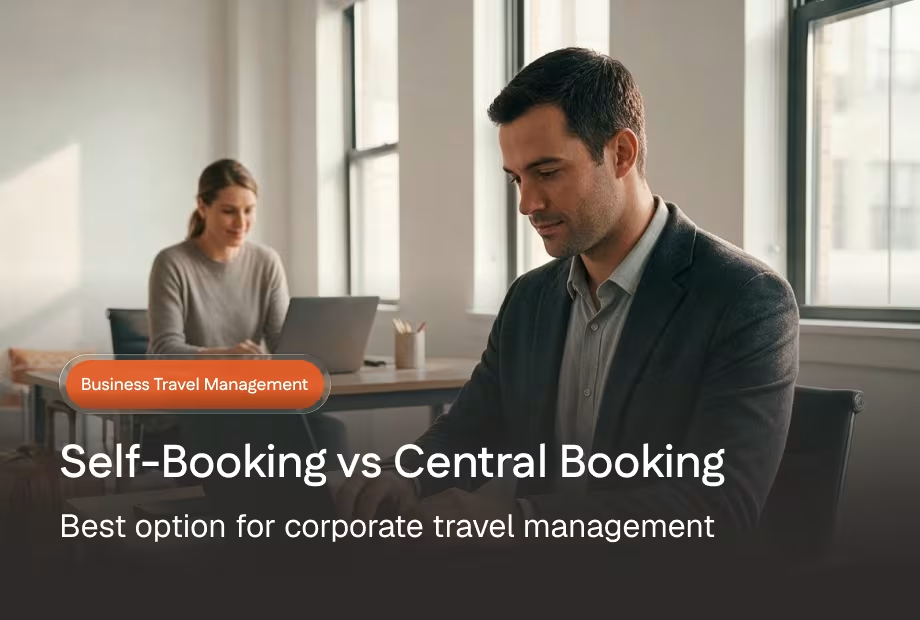
Self-Booking vs Central Booking: Which Corporate Travel Model Should You Design For

Snapshot

- Self-booking means each traveler books their own trip in a tool, within policy. Central booking means a designated person, an executive assistant, an office manager or a travel desk, books on their behalf.
- Neither wins by default. Self-booking suits independent travelers and simple trips; central booking suits executives, complex itineraries and people who cannot self-serve.
- This is not travel agent versus self-booking, which is about outsourcing to an outside agent, and it is not managed versus unmanaged, which is about whether you have a program at all. This is who clicks "book" inside your program.
- Most programs end up hybrid: executives and complex trips get assisted, everyone else self-books with guardrails.
- Design for the mix, not one model, and put both in one platform so policy and visibility do not fork.
- As you grow and AI matures, the mix shifts toward self-serve, because assisted booking is the expensive part.
Has your company just handed you the job of deciding how people should book their travel? Or have you watched self-booking quietly turn into a free-for-all, and now you are wondering whether a travel desk would fix it?
Either way, friend, you are asking exactly the right question, and most companies never stop to ask it. They inherit a booking habit instead of designing one. With business travel spending set to hit a record $1.71 trillion in 2026, that is an expensive thing to leave on autopilot.
Self-booking and central booking are the two ways people actually book trips inside a managed program.
- In self-booking, the traveler does it themselves in a tool.
- In central booking, someone books for them.
The model you pick shapes how fast trips get booked, how much policy holds, how happy your travelers are, and how much time disappears into logistics every week.
At ITILITE, we spend our days inside other companies' travel programs, and we turn what we see into guides like this one. What is in it for you? A clear read on two booking models from people who watch both succeed and fail every week, so you design yours on purpose instead of by accident. And yes, we would love for ITILITE to be the tool you run it on. Let's get into it.
What self-booking and central booking actually mean
Before you choose between them, it helps to be precise, because these two models get muddled with two different questions all the time.
Self-booking is self-service. Each traveler books their own flights, hotels and cars inside a self-booking tool, the software category built for exactly this, with company policy applied as they book. It is fast, it scales with headcount, and it gives travelers control. It asks every traveler to spend a few minutes doing their own logistics.
Central booking, also called booking on behalf or assisted booking, hands the task to a designated person: an executive assistant, an office manager, a team coordinator or a central travel desk. The traveler says where and when; the central booker does the rest. It is hands-off for the traveler and expert for complex trips, and it concentrates the work on a few people.
Two quick clarifications, because this is where the muddle lives. This is not the same as choosing between an outside travel agent and doing it yourself; that trade-off is covered in travel agent versus self-booking. It is also not the same as having a program or not, which is the question in managed versus unmanaged corporate travel. Both of your options here sit inside a managed program. The only question is who does the booking.
Self-booking vs central booking, compared
Seven dimensions separate the two models in practice. Read each one against your own team, because the right model is the one that fits how your people travel.
When self-booking is the right model
Self-booking is the right default once your travelers can be trusted to book inside guardrails, which is most of them, most of the time. It wins when trips are simple and repeatable, when travelers are independent and reasonably travel-savvy, and when you want booking to scale without adding headcount to a desk.
The condition that makes it work is the guardrail, not the goodwill. Policy has to apply as the traveler books, caps have to hold, and payment has to stay on-channel. A self-booking tool that loads your negotiated rates, flags an out-of-policy fare during search, enforces caps benchmarked against something like the federal per diem rates the GSA publishes by city, and pays on a corporate card that keeps spend coded, gives you self-service without the free-for-all. Get that right and self-booking is cheaper and faster than any desk.
When central or admin booking is the right model
Central booking earns its cost in the cases self-service handles badly. Executives are the clearest one: an hour a senior leader spends comparing fares is an hour of expensive time lost, and that opportunity cost usually dwarfs an assistant's time doing it better. For VIPs, booking on their behalf is simply the right call.
It also wins for complex and high-stakes trips. Multi-leg international itineraries, group and event travel, and crews moving together all benefit from one person holding the whole picture.
So do high duty-of-care trips, where the standard employers are measured against, ISO 31030, expects a human eye on risk, not just a self-serve checkout. And it is the only workable model for people who cannot sit at a booking tool, from frontline staff to field crews. This is the daily reality for the assistants who do it; see how they run it in booking travel for multiple executives and how good tooling makes them look sharp in executive assistant smart booking.
An executive assistant at a multinational data company told us they booked travel for the team on one tool while running expenses on another, and spent the gap between the two chasing details by hand. That gap is the central booker tax, and it is why the central booker's tool matters as much as the traveler's. When a trip breaks at midnight, the central booker is also the one on the phone, which is why round-the-clock traveler support belongs in any assisted model.
Why most programs end up hybrid, and how to design it
Here is the answer almost nobody puts on the whiteboard: you are not really choosing one model, you are choosing a mix. The strongest programs run both at once and sort travelers into the right lane.
A simple design holds up well. Executives, VIPs, complex international itineraries and group travel go to a central booker or travel desk. Everyone else self-books inside policy. Frontline and field people get assisted booking or a stripped-down self-serve flow that works on a phone. The rule of thumb: assisted where the stakes or the complexity are high, self-serve everywhere else.
Two design choices make the hybrid work instead of fork. First, run both models on one platform, so policy, negotiated rates, payment and reporting are shared no matter who books; a split across two systems is how visibility disappears. The platform you choose should do self-booking and book-on-behalf natively, not bolt one onto the other, and the corporate travel tools comparison shows which ones do. Second, design the mix to shift. As you grow, and as AI applies policy and finds compliant fares on its own, you can push more travelers to self-serve and shrink the desk, because assisted booking is the expensive part you want to spend only where it pays.
How ITILITE supports both models
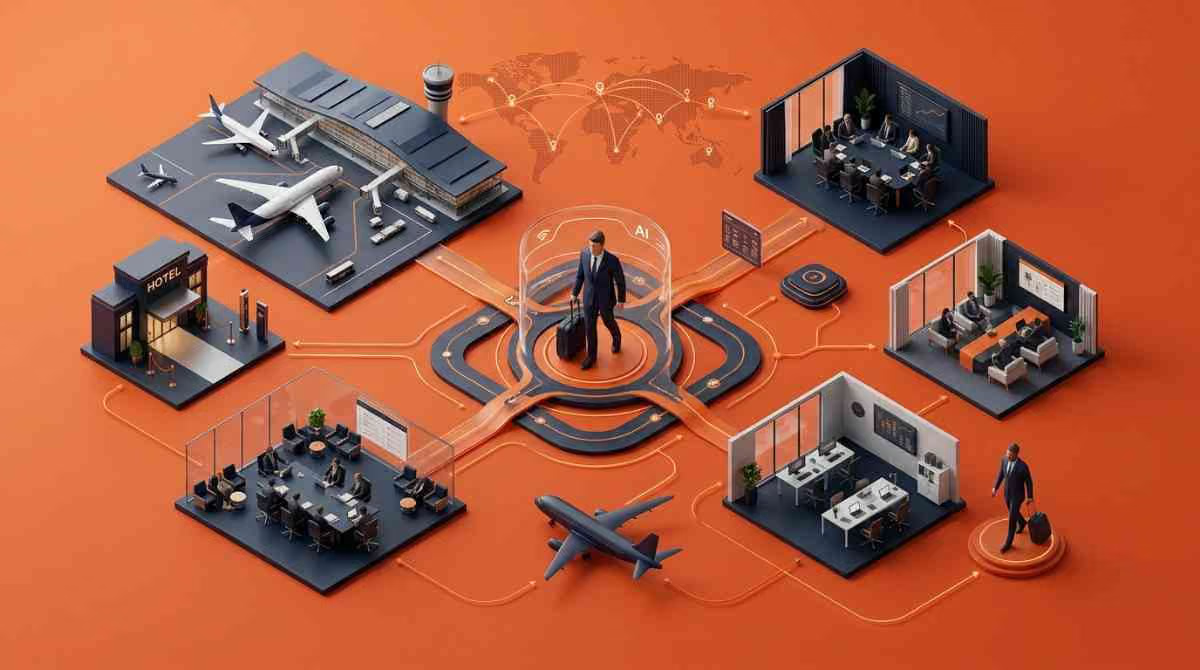
ITILITE runs self-booking and central booking in one platform, which is the point of this whole guide. Travelers self-serve inside policy, while executive assistants and travel desks book on behalf of executives, and both sit under one policy engine, one set of negotiated rates and one dashboard. Whoever clicks "book," the trip is captured, coded and ready to substantiate against the records finance and the IRS expect, so the expense side does not fork even when the booking side is mixed.
Iris, ITILITE's AI travel analyst, pulls weight on both sides: it steers self-bookers toward cheaper compliant options and answers a central booker's travel-data questions in plain language, which is exactly the work that used to need a bigger desk. Pricing is a flat per-trip figure with 24/7 human support included, for the disruptions self-service cannot handle alone. As the name suggests, we try to make itineraries lite, whoever is doing the booking.
FAQ
Who should book corporate travel, the employee or an admin?
It depends on the traveler and the trip. Independent employees on simple domestic trips should self-book inside policy, because it is faster and scales. Executives, VIPs, and anyone on a complex, international or group itinerary are better served by a central booker who books on their behalf. Most companies do both and sort travelers by seniority and trip complexity.
What is a central booker, and what does "book on behalf" mean?
A central booker is a designated person, often an executive assistant, office manager or travel desk, who books trips for other employees. "Book on behalf" is the feature in a travel platform that lets them do it: the central booker searches, applies policy and books under the traveler's profile. It concentrates booking expertise on a few people instead of asking everyone to self-serve.
Is self-booking or central booking better for a company?
Neither is better in the abstract; they fit different travelers. Self-booking is cheaper and faster for independent travelers and simple trips. Central booking is worth its cost for executives, complex itineraries and people who cannot self-serve. The strongest programs run a hybrid and design which travelers fall into which lane.
Can you use both self-booking and central booking?
Yes, and most mature programs do. The key is to run both on one platform so policy, negotiated rates, payment and reporting stay shared no matter who books. Splitting the two models across separate systems is how companies lose a single view of spend and compliance.
Does self-booking save money?
It can, in two ways: it removes the central booker's time from routine trips, and it scales without adding desk headcount. The saving only holds if policy is enforced at the point of booking and spend stays on-channel. Self-booking with no guardrails tends to cost more, because off-channel bookings miss negotiated rates and slip out of policy.
Should executives book their own travel?
Usually not. The time a senior leader spends comparing fares is expensive, and the opportunity cost outweighs what an assistant's time would cost to do it better. Executives are the clearest case for central booking, which is why most programs keep leadership trips assisted even when everyone else self-serves.

Ardra is a Content Strategy Manager at ITILITE with 6+ years of experience in travel and SaaS content. She holds a Master’s degree in Political Science from Lady Shri Ram College for Women and transitioned from academic research and travel content into SaaS content strategy.
She previously worked with JustWravel, where she focused on travel storytelling and digital content. Today, she specializes in SEO and AEO-driven content strategies that help businesses simplify complex travel and expense workflows into search-optimized narratives.
When she’s not working, Ardra is usually reading or watching films.



Run self-serve and assisted booking in one tool
A fully integrated corporate travel management software that dramatically reduces spends while improving user experience
Read More Blogs

Only pay for what you use