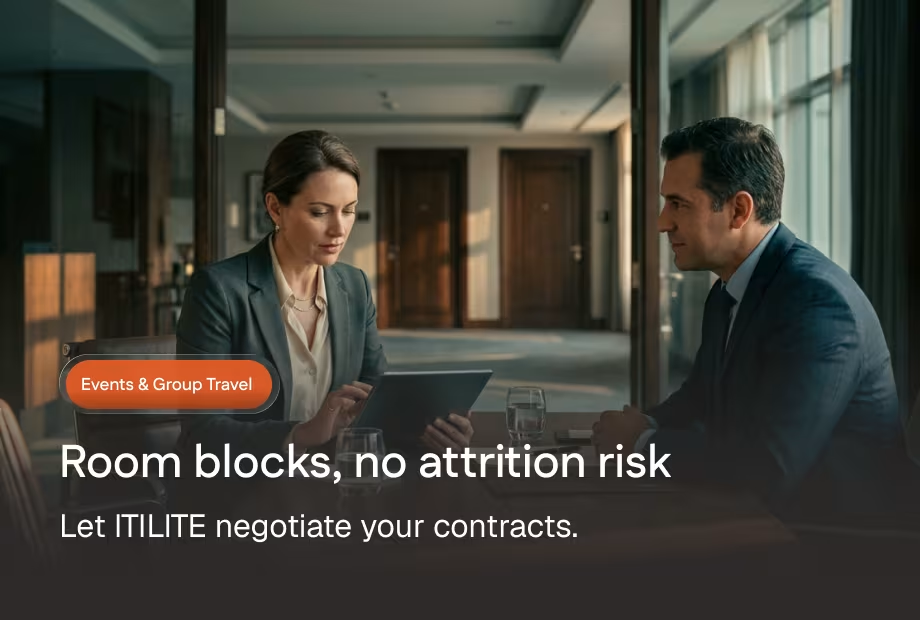
Executive Travel Policy Exceptions: Govern C-Suite Travel Without Chaos



TLDR;
- The C-suite routinely travels outside standard policy, so the goal is to govern exceptions, not pretend they do not happen.
- Business class runs about four times economy, so an ungoverned exception is both expensive and invisible.
- Codify exceptions as role-based tiers with a business justification and an approval path, not per-trip fights.
- Log every exception so finance and the board can see what was approved and why.
- A platform with policy guardrails and out-of-policy flagging turns exceptions into an audit trail, not a black hole.




Your travel policy says economy under six hours and a $300 hotel cap. Your CEO flies business class, books two days out, and stays at the property next to the board meeting. That gap is not a failure of the policy; it is the reality of C-suite travel. The question is not whether executives get exceptions, because they will. It is whether those exceptions are governed and visible, or hidden and unaccountable. This guide shows how to govern them.
Why C-suite travel breaks standard policy
Executives break policy because their travel has different economics, and the biggest is cabin class. A business class ticket runs about four times an economy fare, and three to five times on international routes. For a leader crossing the Atlantic to close a deal, the company usually decides the rested arrival is worth it, which is a legitimate exception, not abuse.
Timing is the second driver. Executives book late because their calendars move late, and fares climb sharply in the final weeks before departure. Add VIP needs like car service, lounge access, or security, and a C-suite itinerary sits outside a standard policy by design. Pretending otherwise just pushes those bookings off-platform, where nobody can see them.
The risk of leaving exceptions ungoverned
Ungoverned exceptions are not a cost problem first; they are a control problem. With business travel spending on course to reach $1.71 trillion in 2026, the premium tier executives occupy is not a rounding error. When an executive's premium booking happens outside any policy or approval, there is no audit trail, so finance cannot explain the spend and the board cannot see what was approved or why. That opacity is exactly where leakage hides: the typical organization loses about 5% of revenue a year to fraud, with expense-reimbursement schemes carrying a $50,000 median loss.
There is a culture cost too. When exceptions are invisible and inconsistent, staff notice that the rules seem to bend for some and not others, which quietly erodes compliance across the wider program. Governed exceptions do the opposite: they make the C-suite's different rules explicit and defensible, so everyone knows the line.
Build an exception framework for the C-suite
The fix is to convert one-off exceptions into a documented framework, so a premium booking is a pre-agreed rule rather than a per-trip argument. The point is to decide the exceptions once, by role, and let the system enforce them. Across ITILITE evaluations, the exception companies codify most often for senior travelers is premium cabin on longer flights, set as a policy tier rather than fought over each time.
A workable framework rests on four moves: define the tiers, require a justification, set who approves, and log everything. The table shows how the common C-suite exceptions map to that.
Two details make the framework hold. First, capture a short business justification on any exception that is not already a pre-approved tier, because "board offsite, refundable fare needed" is what turns a flag into a defensible record. Second, keep the tiers consistent with the wider executive travel policy rather than inventing them per trip, so the exception is part of the policy, not a hole in it.
How a platform enforces exceptions cleanly
An exception framework is only as good as the system that enforces it, which is where a booking platform beats a written document nobody checks. ITILITE runs policy through guardrails and approval matrices, flags out-of-policy choices in real time, and captures the justification at the point of booking, so a C-suite exception is recorded rather than lost. Delegate access lets an executive assistant book the approved exception on the leader's behalf without going off-platform, and every booking lands in one audit trail.
That visibility is what closes the loop with finance and the board. Real-time out-of-policy data means an exception is seen the moment it happens, not discovered at the quarterly review, which is the difference between travel and expense policy compliance that holds and one that leaks.
The same policy best practices apply to executives; the platform just makes the C-suite tier a rule it can enforce. For the assistants who book these trips, ITILITE's travel and expense solutions for executive assistants tie the exception, the approval, and the record together, and the full setup lives on one corporate travel booking platform.
FAQ
What is a travel policy exception?
A travel policy exception is a booking that falls outside the standard rules, such as business class on a route the policy caps at economy, a last-minute fare, or a hotel above the nightly limit. For the C-suite these are routine, so the aim is to pre-define and document them rather than treat each one as a violation.
Should the C-suite be exempt from travel policy?
No, they should have a defined tier within it. A blanket exemption removes visibility and control, which finance and the board need. The better approach is a role-based exception tier that spells out what senior travelers can book, such as business class on long-haul, so the different rules are explicit, approved, and logged.
How do you handle executive travel policy exceptions?
Codify them. Define role-based exception tiers (cabin class, booking window, hotel cap, VIP ground), require a short business justification on anything outside those tiers, set an approval path, and log every exception in one place. That turns a recurring per-trip argument into a documented, auditable rule.
How do you track out-of-policy executive travel?
Use a booking platform that flags out-of-policy choices in real time and captures the reason at booking, rather than reconciling it at month-end. Real-time out-of-policy data gives finance and the board a live view of what was approved and why, and keeps every exception in a single audit trail instead of scattered receipts.
Should executives fly business class?
Often yes, as a governed exception. Business class costs roughly four times economy, so the decision should be a documented role-based rule, typically premium cabin on flights over five to six hours, rather than an unrecorded upgrade. Framed as a tier, it is a defensible business call; left ungoverned, it is invisible spend.
How do you approve travel exceptions?
Pre-approve the standard C-suite tiers so routine premium bookings do not need a fresh sign-off each time, and route anything outside those tiers through an approval matrix with a captured justification. Automating the pre-agreed tiers keeps executives moving while still logging every exception for finance.

Ardra is a Content Strategy Manager at ITILITE with 6+ years of experience in travel and SaaS content. She holds a Master’s degree in Political Science from Lady Shri Ram College for Women and transitioned from academic research and travel content into SaaS content strategy.
She previously worked with JustWravel, where she focused on travel storytelling and digital content. Today, she specializes in SEO and AEO-driven content strategies that help businesses simplify complex travel and expense workflows into search-optimized narratives.
When she’s not working, Ardra is usually reading or watching films.
Govern C-suite exceptions without the chaos
A fully integrated corporate travel management software that dramatically reduces spends while improving user experience