

Last Updated: March 2026
The way you interact with corporate travel management software has fundamentally changed. You no longer log in, search multiple websites, put destinations and dates, or wait on hold for support. In 2026, the best travel management platforms work like an intelligent team member—you “tell” them what you need, and they handle the rest.
Think about it: A CFO doesn’t fill out spreadsheets for their finance team. They delegate. Modern travel software works the same way. Tell it your trip requirements, and it recommends options based on your past preferences, loyalty programs, and company policies. Pick one, confirm, and it books everything—flights through direct airline connections (NDC), hotels, cars—and even codes expenses to the right GL categories automatically.
You’re working harder than you need to, if you are:
- Searching flights across multiple booking sites
- Calling support to make changes or cancellations
- Manually filing expense reports after every trip
- Getting surprised by out-of-policy bookings after they happen
The right TMC (Travel Management Company) gives you an AI agent that handles bookings, manages travel policy automation before purchase, tracks budgets in real-time, and handles expense reconciliation automatically.
Evaluating which TMC fits your company? You’re in the right place. We’ve compared the top 10 platforms based on how they actually work in 2026—real features, verified reviews, honest pricing. Scan the table below to shortlist your top 3 in 60 seconds.
Quick comparison table – in case you’re in a hurry
| Company | Best For | Key Strength | Price |
|---|---|---|---|
| MODERN TRAVEL PLATFORMS | |||
| ITILITE | Companies with 50+ employees | 24/7 live human support with 30-second response time | Travel: $10/trip Expense: $6/user/month |
| Navan | Companies where users self-book | Travelers earn personal loyalty points on business bookings | Travel: $10-$25/trip Expense: $15/user/month |
| Perk | SMBs with Europe-heavy travel | FlexiTravel: Cancel any booking for 80% refund | $99/month + 3% booking fee |
| TravelBank | SMBs prioritizing vendor stability | U.S. Bank ownership and financial infrastructure backing | $5,000/year + $10/user/month |
| TRADITIONAL TMCs | |||
| CTM | SMBs prioritizing vendor stability | 97% client retention rate with dedicated account managers | Custom quote |
| Amex GBT | Large enterprises with global programs | American Express brand and global negotiated rates | Custom quote |
| BCD Travel | Large enterprises with complex programs | Industry’s first Virtual Card Acceptance Rating (hotel payment reliability) | Custom quote |
| Corporate Traveler | SMEs and mid-market companies | Exclusively focuses on SMEs (not scaled-down enterprise) | Custom quote |
| EXPENSE-FIRST TOOLS | |||
| Ramp | Startups/growing companies | Automated expense tracking from booking through reconciliation | $15/user/month + platform fees |
| Expensify | SMBs with sporadic travel | Chat-first super app combining travel, expenses, and messaging | $9/user/month |
Corporate Travel Management in 2026 Runs on Agents, Not Software
The best travel management companies in 2026 operate like intelligent team members you delegate to, not forms you fill out.
1. Conversational Intelligence is Replacing Click-Through Interfaces
You don’t search flight grids anymore. Just tell the platform “Chicago next Tuesday, direct after 9 AM, Marriott under $200″—it handles the rest. The system learns your preferences and knows your company’s policy limits. The more you use it, the better it gets at showing you exactly what you’ll approve. This isn’t a chatbot—it’s an agent just like human that books based on instructions.
2. New Distribution Capability (NDC) is Eliminating Support Dependency
Airlines now send dynamic offers directly to platforms: bundled fares with Wi-Fi and lounge access, negotiated corporate rates, and real-time pricing. Companies using NDC-enabled platforms report 6-12% savings. What used to require calling support—seat upgrades, rebookings—now happens instantly through direct connections.
3. TMCs are Shifting to Proactive Intelligence, Not Reactive Reporting
The smartest platforms act before you ask. When cheaper flights appear, the system re-shops automatically. Unused airline credits get tracked and applied to future trips. Expenses code themselves the moment charges hit. Old software showed you what happened; new platforms take action.
4. Unified Platforms Are No Longer Optional
Modern platforms merge booking, expenses, and cards into one system. Booking triggers payment, payment creates expenses, expenses reconcile automatically. Finance gets real-time spend and recommended actions instead of spending days on reconciliation.
The 10 Best Travel Management Companies, Organized by Type
We evaluated these companies based on verified G2 reviews, real user feedback, and honest pros and cons from actual customers. For each company, you’ll see G2 ratings, transparent pricing, who they’re best suited for, and what they do well (and where they fall short). We’ve organized them into three categories:
- Modern Travel Platforms: built for self-service and automation,
- Traditional TMCs: offering full-service with dedicated agents
- Expense-First Tools that added basic travel to their corporate card platforms. Find your category, compare your top options, and choose what fits.
A. Modern Travel Platforms (Tech first, self serve)
Built for companies with 50+ employees, including global enterprises. These platforms offer sleek desktop and mobile apps where both travelers and central bookers can book instantly without agent support. AI handles policy enforcement, expense reconciliation, and rebooking automatically—giving you control without the administrative burden.
1. ITILITE
- G2 rating (2026): 4.4 / 5
- Best for: Companies with more than 50 employees
- Pricing: $10 per trip for travel, $6 / month / user for expense. Free Corporate Cards
- Category: Modern Travel Platform
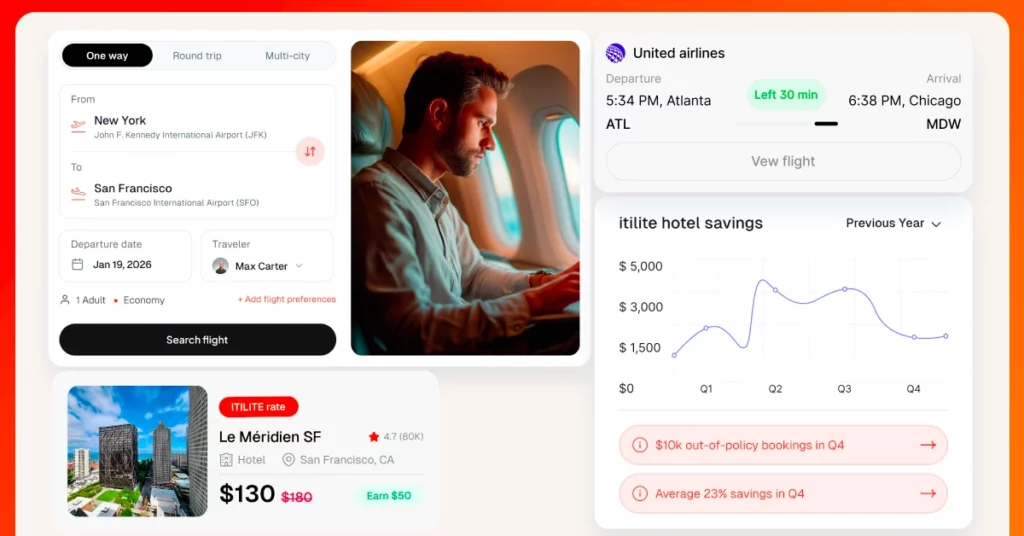
ITILITE combines travel booking, expense management, and corporate cards in one platform. The company has deep relationships with airlines, hotels, and car rental suppliers globally, securing negotiated rates not available on consumer sites. Combined with both GDS and modern NDC airline connections, you get wider inventory and consistently better prices.
The platform lets employees book freely while staying in budget by nudging them toward cost-effective options. Companies report reducing travel costs without restricting choice by 20–30%.
Unlike traditional TMCs that bundle fees into contracts, ITILITE runs on straightforward per-trip pricing — $10 per trip for travel and $6 per active user per month for expense management.
What sets ITILITE apart: 24/7 live human support with a 30-second response time. When flights get canceled or you need complex rebooking, you get an actual person solving it – not an AI chatbot.
What users like about ITILITE
Based on reviews on G2, ITILITE users consistently highlight three themes: intuitive usability, responsive human support, and visible cost savings. Many reviewers mention that the platform requires little to no onboarding effort. Expense submission in particular is described as simple and fast, with flexible receipt uploads and easy category selection. Mobile usability also stands out, especially for employees managing travel on the go.
Support quality is another recurring strength. Users frequently reference fast response times and helpful live assistance during disruptions or complex bookings. Several reviews also point to transparent booking fees and negotiated carrier savings as tangible financial benefits.
An enterprise user on G2 appreciated the platform’s versatility:
Itilite has quickly become one of my favorite apps, thanks to its sleek design and powerful features. The app versatility allows me to stay calculated, organized, informed, and connected, all from the convenience of my mobile device. I appreciate the attention to detail and dedication to user satisfaction that the developers have put into it.
Another G2 review highlights great customer support:
Itilite has provided exceptional customer service, flat rate booking fees, and has helped us secure additional cost savings directly from the major carriers.
What users dislike about ITILITE
Critical feedback tends to focus on incremental usability refinements rather than structural gaps. Some users have noted that search functionality could be improved, particularly around auto-populating locations when typing airport or business names.
For example, one G2 review mentioned:
The one thing I would change is the ability to type in a business such as an airport name and the location auto populate.
There are also occasional references to earlier versions of the travel app feeling less fluid, though users acknowledge active updates addressing those concerns:
Sometimes the Travel app can be clunky, but they have released a new revision that positively addressed many of the concerns.
Overall, the feedback reflects product polish requests rather than limitations in core travel, expense, or support capabilities.

2. Navan
- G2 rating (2026): 4.7 / 5
- Best for: Companies where users book for themselves (no central-booking)
- Pricing: $10-$25 per trip for travel, $15 / month / user for expense.
- Category: Modern Travel Platform
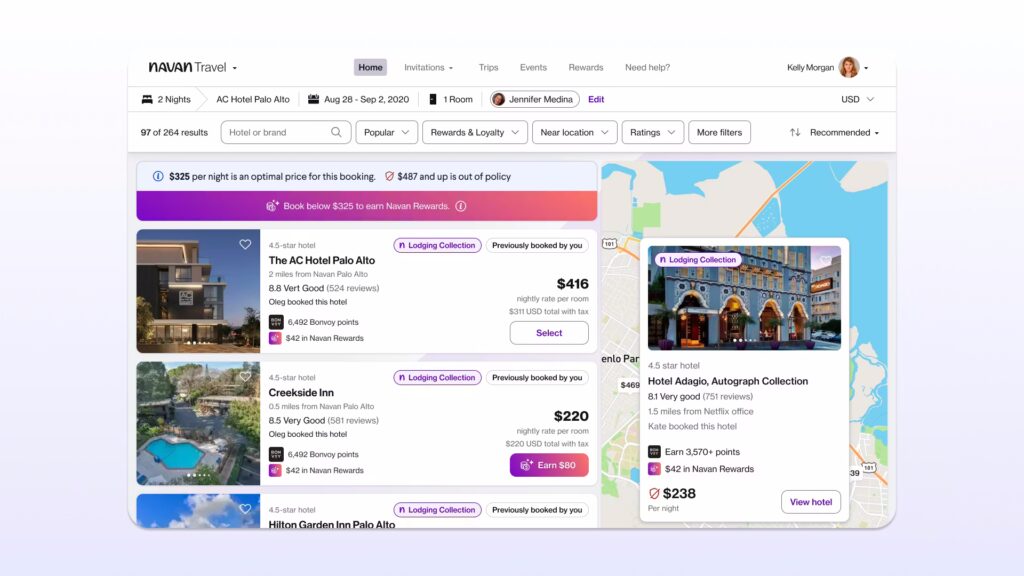
Navan offers a modern, app-based travel platform praised for its intuitive user experience. Companies where employees self-book frequently choose Navan for its sleek interface. The platform includes global inventory with customizable policies, approvals, and consolidated reporting.
What sets Navan apart: travelers earn personal loyalty points and rewards when booking business travel—essentially getting credit card-style perks while following company policy.
However, recent user feedback points to support quality concerns. Navan relies heavily on AI-powered customer service, which handles routine queries but struggles with complex rebooking scenarios, flight disruptions, or policy exceptions where travelers need immediate human assistance.
What users like about Navan
Across reviews on G2, Navan is most frequently praised for its intuitive interface and smooth self-booking experience. Users consistently describe the app as modern, easy to navigate, and quick to adopt without extensive training.
For companies where employees book their own travel, this usability becomes a major advantage. Travelers appreciate being able to search, book, and submit expenses within a single streamlined flow. The platform’s design and mobile experience are recurring strengths in user feedback.
For a detailed breakdown of pricing, support model, and feature differences, see our full ITILITE vs Navan comparison.
As one reviewer noted:
I like the UI of the Navan app. I feel like it’s easy to use and easy to navigate.
Another user echoed the same theme:
The platform is easy to use and intuitive, making travel bookings and expense submissions quick.
The consistent takeaway: Navan delivers a polished, self-service experience that reduces friction for frequent business travelers.
What users dislike about Navan
Critical feedback around Navan tends to center on customer support responsiveness and pricing transparency. Several reviews indicate that while routine queries are handled efficiently, complex issues such as rebookings, disruptions, or technical problems can take longer to resolve than expected. In high-stress travel scenarios, delayed human intervention becomes a recurring concern.
One G2 reviewer shared:
Recently we had a security breach that went all the way up to their senior IT manager. It took an escalation to finally get real answers and understanding of the breach. It took nearly three weeks to get any resolution or clarity.
Another user highlighted extended resolution timelines:
I contacted support repeatedly for several weeks, and despite numerous chats with different agents and empty promises of updates within 72 or 5 hours or during the day, I never received a working PNR or confirmation of both flights.
Pricing perception is another theme in negative reviews. Some users report that they occasionally find lower rates when booking directly with airlines or hotels:
I’ve noticed that Navan doesn’t always give me the absolute lowest price when I go straight to some properties, airlines, or travel apps.
Companies that have shortlisted Navan but want to see how it compares to the full competitive set can find a detailed breakdown in our guide to Navan alternatives.
Overall, while Navan earns strong marks for usability, user criticism focuses primarily on support escalation during complex situations and perceived pricing inconsistencies.
3. Perk (formerly TravelPerk)
- G2 rating (2026): 4.6 / 5
- Best for: SMBs with Europe – heavy travel
- Pricing: $99 per month + 3% of booking fees
- Category: Modern Travel Platform
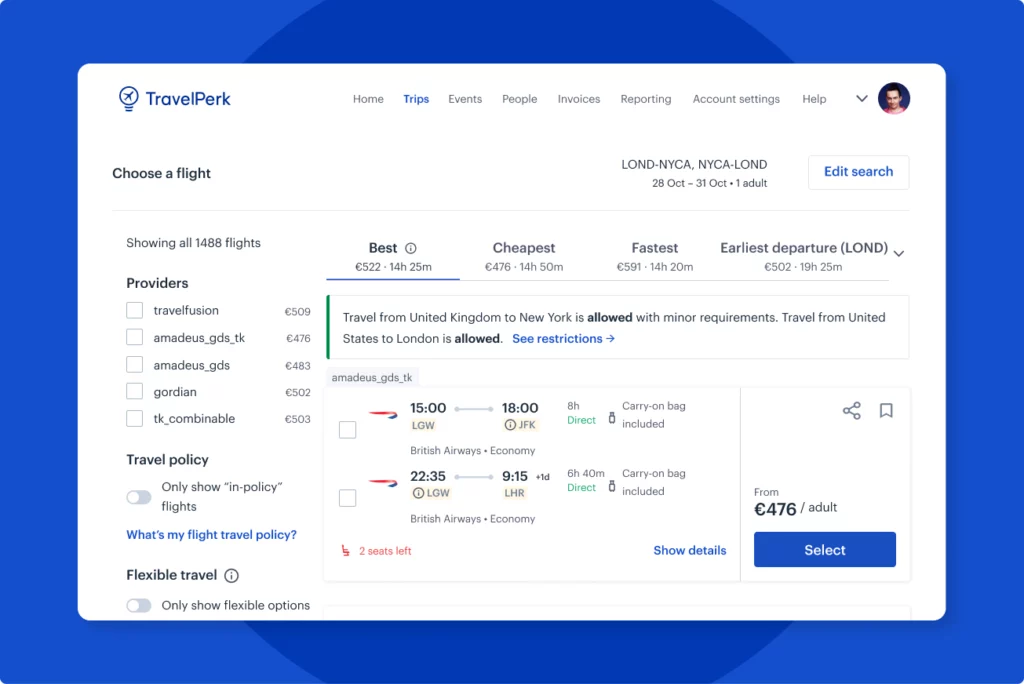
TravelPerk (rebranded as “Perk” in late 2025) is a Barcelona-based travel platform serving primarily SMBs across Europe and the U.S. It offers global travel inventory with customizable policies, approvals, and reporting. In January 2025, TravelPerk acquired Yokoy to add native expense management, completing its full T&E offering.
The platform is ideal for companies wanting to start booking travel with minimal setup complexity—onboarding takes days, not weeks.
What sets TravelPerk apart: FlexiPerk (now FlexiTravel), which lets companies cancel any booking for an 80% refund by paying a 10% upfront fee – far cheaper than buying flexible airline fares that typically cost 60% more.
What users like about Perk
Based on reviews on G2 and other review platforms, Perk is most often praised for its ease of use and quick onboarding.
Another recurring theme is loyalty program integration. Travelers appreciate being able to connect personal rewards programs and continue earning miles or hotel points while booking within company policy. For SMBs especially, this balance between corporate control and traveler perks resonates strongly.
Companies running into inventory gaps or pricing concerns with Perk may want to explore TravelPerk alternatives with broader global coverage before committing.
One G2 reviewer shared:
I like how Perk makes it easy to track and submit expenses, as well as book corporate travel. I also enjoy being able to connect my loyalty program and earn personal rewards like miles, so I still get rewarded for booking through this corporate travel portal.
The consistent takeaway: Perk appeals to growing companies that want a low-friction setup and a familiar, traveler-friendly booking experience.
What users dislike about Perk
Critical feedback around Perk tends to focus on inventory depth and pricing competitiveness. Several users report limited travel options compared to consumer booking sites, particularly when searching for broader hotel or flight availability. In some cases, travelers mention booking outside the platform when they cannot find suitable options.
One reviewer noted on G2:
The main problem I found is that there are not enough options.
Another user echoed the same concern:
Platform has limited options – end up booking my trips on Expedia.
Pricing perception also appears in reviews. Some users mention that rates can be higher than booking directly with providers or third-party travel sites:
Their prices are much higher than booking direct with nearly all hotel providers and 3rd party sites.
Overall, while Perk earns positive marks for usability and simplicity, recurring criticisms center on inventory breadth and price competitiveness versus direct booking channels.
4. TravelBank
- G2 rating (2026): 4.5 / 5
- Best for: SMBs prioritizing vendor stability
- Pricing: $5000 yearly platform fees for travel, $10 / user / month for expense
- Category: Modern Travel Platform
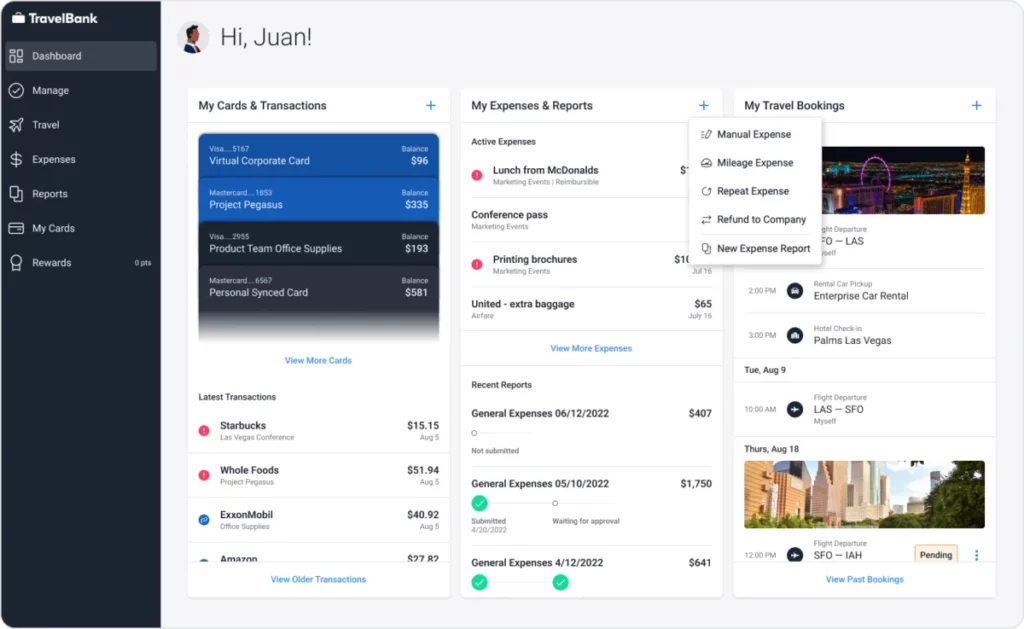
TravelBank is a San Francisco-based platform founded in 2015, acquired by U.S. Bancorp in 2021. The platform combines travel booking, expense management, and corporate cards in a mobile-first application targeting SMBs. Companies can set custom budgets and policies, with employees guided toward cost-effective choices through real-time predicted budgets.
What sets TravelBank apart: U.S. Bank ownership. Unlike standalone startups, it operates with the financial backing and infrastructure of a major banking institution—which some finance teams view as lower-risk, though the platform itself functions like any modern travel software.
What users like about TravelBank
User reviews frequently highlight TravelBank’s ease of use and mobile-first expense reporting. Receipt capture is a recurring strength, with customers appreciating the ability to snap photos on their phone and have transactions automatically matched without manual reconciliation.
Several users also mention how intuitive the interface feels, particularly for mileage tracking and agency expense reporting. Automated reminders and clear transaction visibility help reduce reporting errors and save time.
One G2 reviewer shared:
I enjoy how you can snap photos of your receipts on your phone, and it automatically uploads them and even merges them with transactions on your card so you don’t have to worry about doing that. The initial setup of TravelBank was very easy.
Another user emphasized time savings:
It is user-intuitive, and there are reminders for places if you forget to fill in certain fields… it has cut down my reporting time from 20 minutes for one work travel episode to just a few minutes at most!
The consistent takeaway: TravelBank is valued for simplifying expense capture and reducing reporting time, especially for teams with frequent travel.
What users dislike about TravelBank
Booking limitations and software reliability are the area of concerns. Some users report limited hotel inventory or the inability to book preferred properties directly within the platform. Others mention that fares are not always the most competitive compared to booking directly with airlines or third-party travel sites.
One reviewer noted:
Sometimes the fares I see aren’t as cost-effective/time-effective as what I see on the open market i.e. airline websites, Orbitz, et al.
Another recurring concern involves system stability:
The Travel Bank software can be extremely glitchy. Sometimes attempting to book can become cumbersome due to issues with the software. The same unfortunately is true for the iPhone app.
Users also mention friction around editing travel plans and minor UX confusion:
I don’t like that you have to contact customer service to edit travel plans.
The overall pattern suggests that while TravelBank performs strongly on expense usability, some users experience limitations around inventory depth, price competitiveness, and booking flexibility.
B. Traditional TMCs (Full-Service with Agents)
These are legacy players with decades of expertise and dedicated consultants. The service model relies heavily on agent interaction—bookings, changes, and complex itineraries typically require multiple touchpoints with your assigned consultant rather than self-service through an app or platform
Pricing for these traditional TMCs is not available online. They usually have a custom quote tailored for each client. Their fees usually involve trip booking fees ($5 – $25 + per trip), management fees (monthly fixed retainer), and service charges (separate fees for 24/7 support and changes).
1. Corporate Travel Management (CTM)
- G2 rating (2026): 1.8 / 5
- Best for: SMBs prioritizing vendor stability
- Pricing: Custom quote
- Category: Traditional TMC
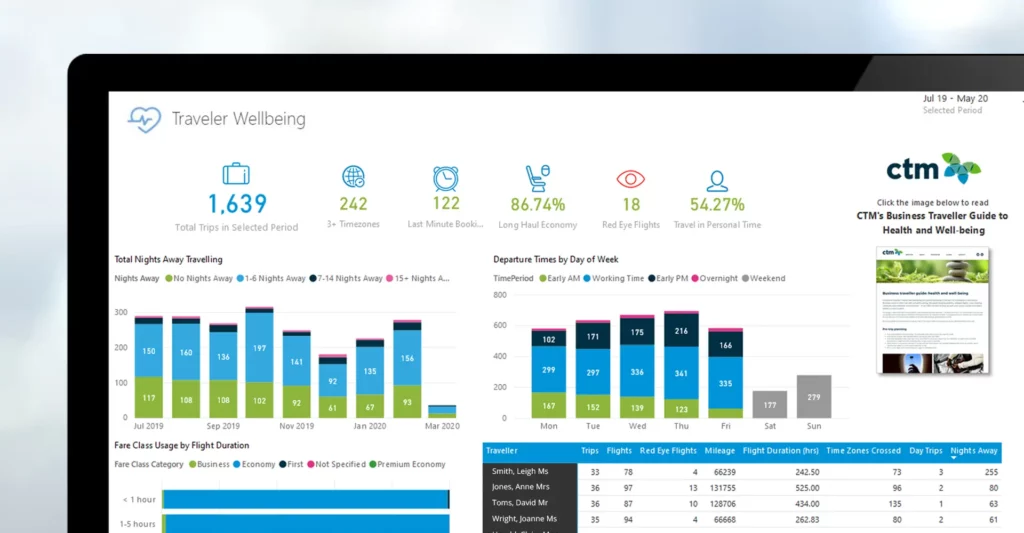
Corporate Travel Management (CTM) is an Australian-founded TMC established in 1994, now the world’s 4th largest travel management company. The platform operates across North America, Europe, and Asia-Pacific with local service teams in each region. CTM combines its proprietary “Lightning” online booking tool with traditional agent support—travelers can self-book or call consultants for complex itineraries.
What sets CTM apart: a 97% client retention rate driven by dedicated account managers who function as extensions of client teams. The company claims to answer customer call in under 90 seconds, however, user reviews have voiced concerns of long hold times with customer support.
What users like about CTM
Based on reviews across platforms like Trustpilot, CTM is most commonly praised for its dedicated account management and hands-on service model. Customers who value having a named point of contact often highlight responsiveness at the account level and the feeling of having an extended team member managing their travel program.
One Trustpilot reviewer noted:
Our manager is very helpful and reaches out all of the time.
What users dislike about CTM
Critical feedback tends to center on servicing delays and limited self-service flexibility. Several reviews point to long hold times when contacting support, particularly during urgent situations. This stands in contrast to the company’s stated response benchmarks and appears to be a recurring frustration in user feedback.
One reviewer on Trustpilot shared:
I sat on hold for two and a half hours before giving up on them. Embarrassingly incompetent day-to-day service and after hours ‘support’ is a joke.
Another common theme is the inability to modify bookings independently through the online system, requiring agent intervention for relatively simple changes. As one user put it:
They have an online system that you can’t use to change or cancel flights so have to phone them up to do a 5 minute flight change and then charge $300 for it.
The overall pattern suggests that while CTM’s traditional service model works well for clients who prefer human-led management, it can introduce friction for travelers who expect instant, self-service control over bookings and changes.
2. Amex GBT (Egencia)
- G2 rating (2026): 4.5 / 5
- Best for: Large enterprises with global travel programs
- Pricing: Custom quote
- Category: Traditional TMC
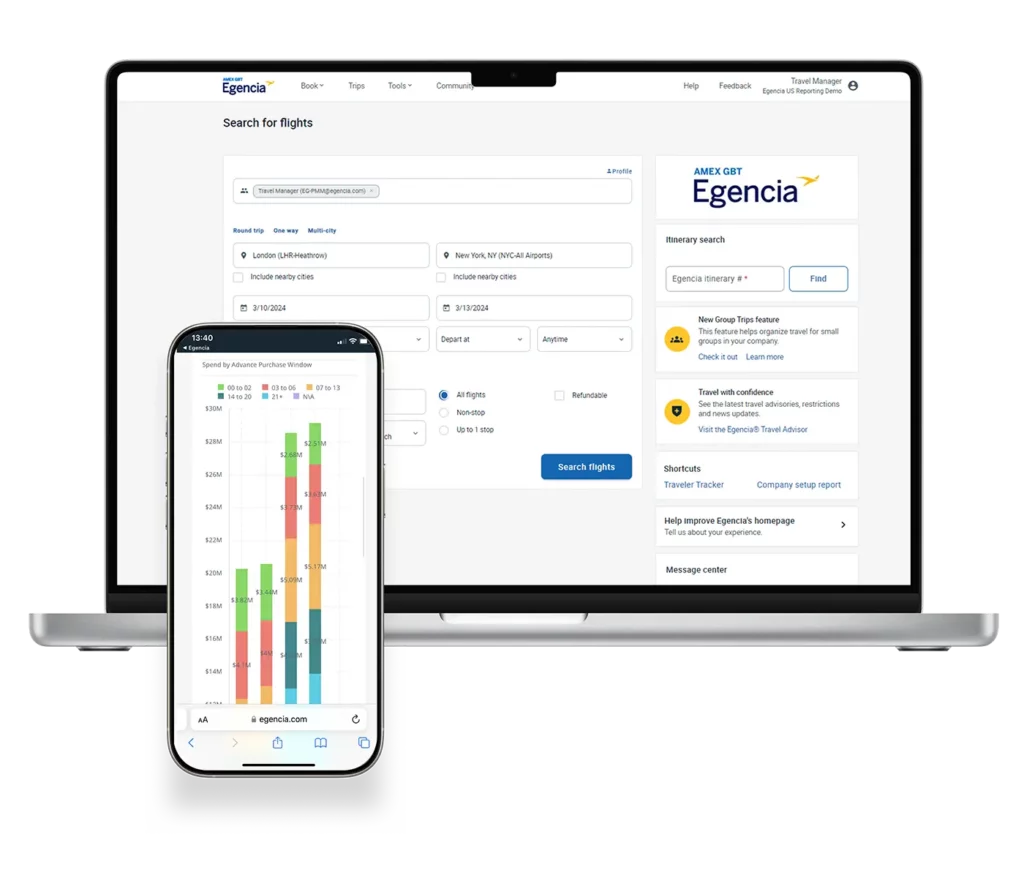
American Express Global Business Travel (Amex GBT) is the world’s largest B2B travel platform, publicly traded since 2022 with operations across 140+ countries. Egencia is Amex GBT’s self-service booking brand offering AI-driven search, mobile apps, and integration with expense systems. The platform serves companies from mid-market to Fortune 500 with both online booking tools and agent support.
What sets Amex GBT apart: the American Express brand backing and global buying power. Companies get access to negotiated rates, exclusive NDC airline fares, and 24/7 traveler support backed by the American Express network and reputation.
What users like about Amex GBT
Users appreciate Amex GBT’s ability to coordinate complex itineraries across airlines and keep travel details organized in one place. Consolidated communication and clear scheduling appear to be strengths, particularly for multi-leg or international trips.
As one G2 reviewer noted:
They’re able to communicate between the different airlines and really make sure the schedule is straightforward and easy. It’s also great that your itinerary is right there in your inbox, making it convenient.
What users dislike about Amex GBT
Recurring criticism focuses on platform reliability and technical issues during booking. Some users report frequent site problems that disrupt the booking process and create friction in day-to-day use.
One reviewer on G2 shared:
Site has issues almost daily, and multiple issues at that. It was working for me a year ago, now that we are completely invested the site has technical issues that make it impossible to continue using.
Another user highlighted booking challenges tied to system failures:
I honestly feel sometimes I just spend extra time trying to book with them to always have some issues; once their system even blocked the airline system so even the airline couldn’t even assist me.
The pattern in user feedback suggests that while Amex GBT offers strong travel coordination capabilities, technical stability has been a concern for some customers.
3. BCD Travel
- G2 rating (2026): – (no reviews on G2)
- Best for: Large enterprises with complex travel programs
- Pricing: Custom quote
- Category – Traditional TMC
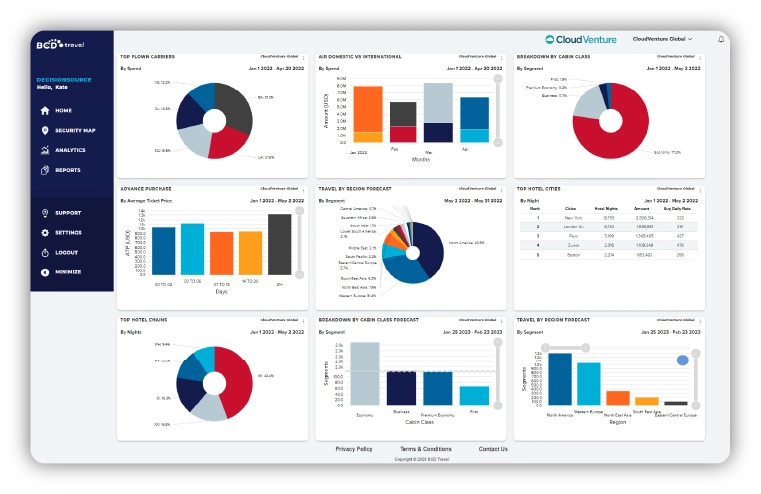
BCD Travel is one of the world’s largest TMCs with $22.9 billion in annual sales across 170+ countries. They serve major enterprises through a blend of global infrastructure and modern technology, handling everything from complex international travel programs to meetings and events management. Their 15,000+ team members provide 24/7 support with deep regional expertise.
What makes BCD stand out: Massive negotiating leverage with airlines and hotels that newer platforms can’t match. In December 2025, they launched the industry’s first Virtual Card Acceptance Rating—scoring hotels 1-10 on payment reliability, eliminating the “front desk can’t find my card” problem before it happens.
What users like about BCD Travel
User feedback highlights responsive support when additional assistance is required beyond the company’s online booking tool. While many bookings are handled through integrated systems like Concur, customers note that BCD’s agents provide timely guidance when issues arise.
One Trustpilot reviewer shared:
Whenever I need extra support next to the company tool Concur, they are very quickly to respond and give me great advice… when I need their advice they are there for me and offer timely service.
What users dislike about BCD Travel
The most consistent criticism in user reviews centers on pricing concerns. Some customers report significantly higher costs compared to booking directly with airlines or hotels, raising affordability issues for certain organizations.
One Trustpilot reviewer stated:
I was booked with a budget airline, the airline website lists the tickets price around 80 pounds but the BCD bill came for over 500 pounds.
Another review reflects similar concerns:
I need to use BCD travel for booking my trips for the University I work for. This makes the travelling so much more expensive that I almost can’t afford the field-trips I am doing with my students.
The pattern in feedback suggests that while support is valued, pricing transparency and cost competitiveness are recurring concerns among some users.
4. Corporate Traveler
- G2 rating (2026): – 4.8 / 5
- Best for: Large enterprises with complex travel programs
- Pricing: Custom quote
- Category: Traditional TMC
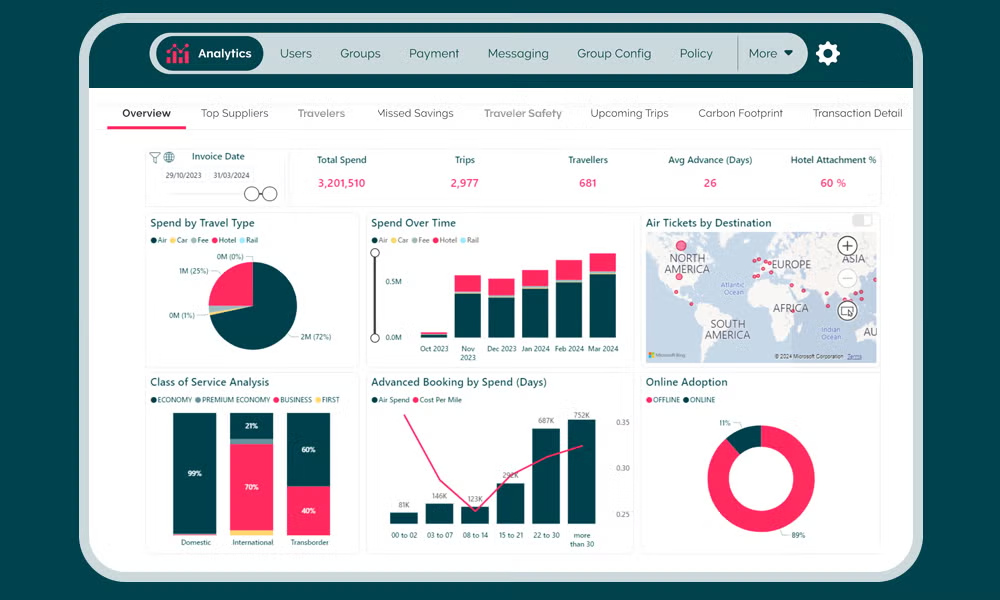
Corporate Traveler is Flight Centre Travel Group’s SME-focused brand, exclusively serving startups and mid-market companies with 14,000+ businesses globally. Unlike enterprise TMCs scaled down, they’re built from the ground up for smaller travel programs. Their proprietary Melon platform combines self-service booking with dedicated travel consultants—handling flights, hotels, and cars with AI-driven search that learns company preferences and enforces policy automatically. The platform switches seamlessly between mobile and desktop, integrates with major expense systems, and includes 24/7 chat support from real agents, not just bots.
What makes Corporate Traveler stand out: They’re the rare TMC that exclusively focuses on SMEs rather than treating them as scaled-down enterprise clients.
What users like about Corporate Traveler
User feedback highlights an easy rollout process and strong onboarding support. Customers frequently mention that implementation is smooth and that account managers are accessible when assistance is needed.
One G2 reviewer shared:
It was very easy to roll out to my crew, and customer support is always available when we need help.
Another user praised the setup experience:
The initial setup was super smooth, and the Corporate Traveler employees were the best at assisting our employees.
The consistent takeaway: Corporate Traveler is appreciated for straightforward implementation and hands-on support during onboarding.
What users dislike about Corporate Traveler
Key concerns are focused on international inventory limitations and additional service or modification fees. Some users report fewer flight options for international routes, particularly for companies with global travel needs.
As one G2 reviewer noted:
Relative lack of breadth of flight options >> particularly when dealing with international routes considering much of our travel is international.
Another recurring concern involves booking modification charges:
You are charged if they alter a booking ($90+), and you are also charged $25+ if you alter a booking on their web portal yourself!
The overall pattern in user feedback suggests that while Corporate Traveler performs well in onboarding and support, companies with extensive international travel programs or sensitivity to modification fees may experience friction.
C. Expense-First Tools
Expense / Corporate card companies that added flight and hotel booking as a secondary feature. Suitable if expense management is your main priority and you only need basic, occasional travel functionality on the side.
1. Ramp
- G2 rating (2026): – 4.8 / 5
- Best for: Startups / growing companies evaluating new card / expense platforms
- Pricing: $15 / user / month + platform fees
- Category: Expense – First Tools
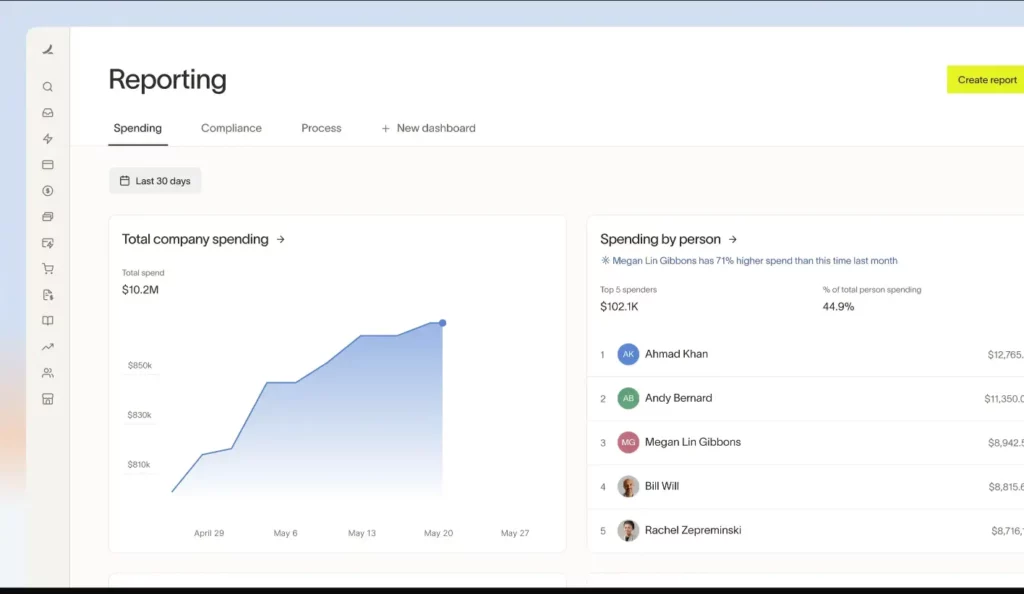
Ramp is a cards and expense management platform that added travel booking in June 2024 through a Priceline partnership. Companies can book flights and hotels directly within Ramp without separate booking fees (they have an all-in-one pricing model). Travel policies auto-enforce during booking, and transactions flow into Ramp’s expense system.
What makes Ramp stand out: Corporate cards program with granular spending controls extending into travel. Native integration creates automated expense tracking from booking through reconciliation—eliminating the disconnect between cards, bookings, and expenses.
The platform requires using Ramp cards, which isn’t ideal for companies with existing corporate card programs.
What users like about Ramp
User reviews frequently highlight Ramp’s real-time expense visibility and automation capabilities. Customers appreciate being able to see transactions almost immediately and streamline receipt collection and approvals without manual follow-ups.
One G2 reviewer shared:
The ability to see purchases in near real time and immediately request any missing receipts is a huge improvement over our previous employee credit card system.
Others emphasize the value of accounting integrations and workflow automation:
I really appreciate the accounting integration, as well as the receipt management and the bill pay and approval process. These features have saved us hours each day and have provided us with much greater transparency when working with our clients.
The consistent takeaway: Ramp is praised for improving finance visibility and reducing manual effort across expense management workflows.
What users dislike about Ramp
The most common criticism relates to fluctuating credit limits tied to cash balance. Some users report that dynamic spending limits make it difficult to plan weekly cash flow, particularly for smaller companies with variable balances.
One G2 reviewer noted:
The least helpful about Ramp is that they set an amount that you are able to use up front. Then it changes and gets smaller as your bank account gets smaller.
Another user echoed similar concerns:
“Credit limit not static – we cannot adequately plan weekly cash when our credit limit changes when we have larger weekly expenses. More manual than anticipated for entering accounting coding.”
The recurring theme in feedback suggests that while Ramp excels in automation and visibility, its dynamic credit model can create unpredictability for companies that require stable spending limits.
2. Expensify
- G2 rating (2026): – 4.5 / 5
- Best for: SMBs with sporadic travel requirements
- Pricing: $9 / user / month
- Category: Expense – First Tools
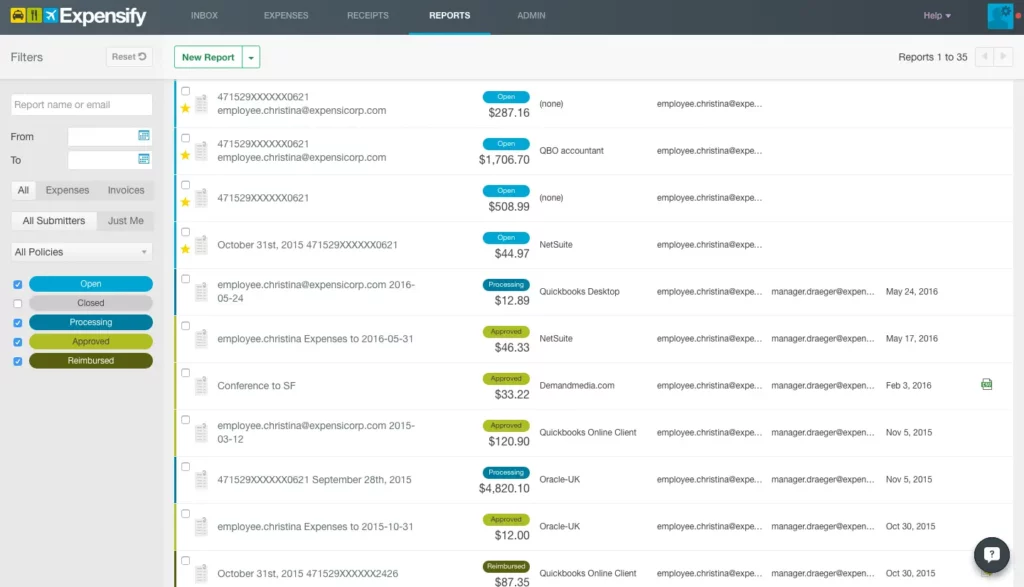
Expensify is a publicly traded expense platform (Nasdaq: EXFY) that launched Expensify Travel in May 2024, built on Spotnana’s infrastructure. The platform integrates travel booking into their chat-based “New Expensify” app, allowing users to book flights, hotels, and cars alongside expense management and team messaging. Spotnana handles backend servicing while Expensify provides the interface. With 12M+ users, it’s fairly established among SMBs, though the travel offering is fairly new and lacks modern capabilities.
What makes Expensify stand out: Chat-first interface where travel, expenses, and communication happen in one conversational flow. The “super app” approach appeals to companies wanting simplified workflows over specialized travel features.
What users like about Expensify
User reviews frequently highlight Expensify’s receipt management and automated expense creation features. Customers appreciate the ability to store receipts in one place and have them automatically matched to corresponding transactions.
Companies that find these limitations recurring at scale may benefit from reviewing Expensify alternatives with stronger card reconciliation and travel integration.
One G2 reviewer shared:
It keeps all receipts in one place and matches them with their charges, which is efficient.
Another user praised the scanning functionality:
I like how Expensify scans and creates expenses from actual receipts, which saves me from manually entering receipt information.
What users dislike about Expensify
Performance issues at scale and system reliability challenges are the main concerns. Some mid-market users report difficulties when handling higher volumes of receipts or card transactions.
One reviewer noted issues with bulk uploads:
If you want to manually upload receipts one by one, then do hand categorization; this is the tool for you! If you want to bulk upload receipts, you will absolutely crash the system.
Another mid-market user highlighted recurring integration problems:
Card imports constantly break and often simply aren’t fixable.
The overall pattern in user feedback suggests that while Expensify works well for smaller teams with straightforward expense needs, some companies experience limitations when usage volume increases.
Conclusion – which travel management company to choose
Corporate travel management in 2026 isn’t about finding the “best” platform—it’s about finding the right fit for your company’s size, travel patterns, and priorities. Modern platforms excel at self-service and automation. Traditional TMCs deliver dedicated support and negotiating power. Expense-first tools integrate naturally if you’re already using their cards.
The companies covered here represent different approaches to the same problem: making business travel easier to book, track, and manage. Your decision comes down to whether you prioritize technology, human support, or financial integration.
For a broader view that goes beyond TMCs specifically, our roundup of the best travel and expense management software in the US covers platforms across every budget and company size.
Start with three demos from the category that matches your needs, then let your team’s actual experience guide the final choice.